Is TCPA A Four-Letter Word? – Corporate and Company Law – Corporate/Commercial Law

SJ
Steptoe LLP

In more than 100 years of practice, Steptoe has earned an international reputation for vigorous representation of clients before governmental agencies, successful advocacy in litigation and arbitration, and creative and practical advice in structuring business transactions. Steptoe has more than 500 lawyers and professional staff across the US, Europe and Asia.
One of the plaintiffs’ class action bar’s favorite play toys is the federal Telephone Consumer Protection Act of 1991(TCPA), which imposes a host of requirements and constraints on telephone calls…
United States
Corporate/Commercial Law
To print this article, all you need is to be registered or login on Mondaq.com.
One of the plaintiffs’ class action bar’s
favorite play toys is the federal Telephone Consumer Protection Act
of 1991(TCPA), which imposes a host of requirements and constraints
on telephone calls and text messages made on behalf of a business
both to other businesses and to consumers.
Plaintiffs are entitled to receive $500 to $1,500 in statutory
damages for each call placed in a manner that violates any of the
Act’s requirements. Those damages can be aggregated across a
class and the Act does not cap the amount a defendant must pay for
TCPA violations in any way. Presumably for that reason, recent TCPA
class action settlements have averaged almost $7 million per case,
according to a September 2024 CRC Group report. And presumably for
that reason, new TCPA complaint filings increased 98% year over
year in 2023 and another 17.6% through the first five months of
2024, the report says.
No industry is immune to TCPA scrutiny, and a company need not
have directly engaged in the challenged conduct to have liability
exposure. In March of this year, for example, Allstate was held
vicariously liable by a federal court in Illinois for TCPA
violations based on calls placed by a third-party telemarketer
(Atlantic Telemarketing) that was subcontracted by a different
third-party telemarketer (Transfer Kings) that had been hired by
two Allstate agents to place telemarketing calls regarding
insurance quotes.
Allstate itself apparently was unaware that two of its agents
had hired Transfer Kings and the Allstate agents may not have known
that Transfer Kings engaged Atlantic Telemarketing. Allstate
nevertheless was subject to statutory damages for each of Atlantic
Telemarketing’s calls to the plaintiff. Because the court
previously had denied class certification, however, the damages
award was relatively small ($18,000 total stemming from 12
calls).
Not all companies are that lucky, though. In 2020, for example,
dietary supplement company ViSalus was on the wrong end of a $925
million jury verdict even though that defendant had evidence of
“prior express consent” from each recipient of its calls.
However, it did not have the requisite heightened level of
“prior express written consent” necessary to place the
“robocalls” at issue. (The excessive amount of the award
caught the attention of the Ninth Circuit, which remanded the case
to district court for further analysis of whether the damages were
constitutional; it is still ongoing.)
Many businesses—including insurance agencies and brokerage
firms—often call and text existing clients for normal-course
account servicing and to offer additional valuable products and
services. Many of your firms likely also regularly call and text
prospective personal lines customers. To help you limit exposure,
here is an overview of the TCPA’s rules for calling and
texting.
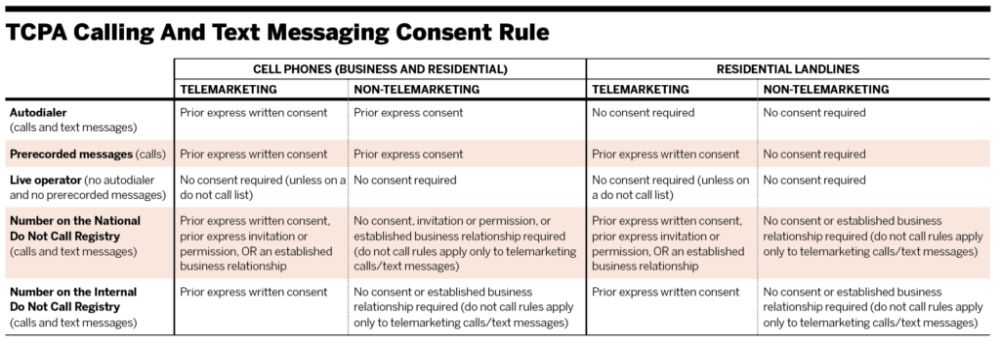
Autodialers and Prerecorded Messages. First,
the TCPA prohibits non-emergency calls or text messages placed or
sent via an “automatic telephone dialing system” (i.e.,
an autodialer) or that use an artificial or prerecorded voice
(i.e., a prerecorded message) to any cell phone without the
recipient’s consent.
For non-telemarketing autodialed or prerecorded message
communications, a company only needs the consumer’s “prior
express consent,” which is generally deemed to exist whenever
the consumer has voluntarily provided the caller/texter with his or
her telephone number. For example, prior express consent typically
would exist where a policyholder has provided an insurance agent
with his or her cell phone number as part of the policy application
or binding process.
In order to use an autodialer or prerecorded message to
telemarket, a company must have the recipient’s “prior
express written consent.” That is a heightened standard,
requiring a written agreement that includes:
- The signature of the recipient (either traditional
“wet” signature or an electronic/digital one) that
clearly authorizes the specific company to deliver telemarketing
calls or messages - The telephone number to which the signatory authorizes such
telemarketing communications - A clear and conspicuous disclosure stating both that (a) the
calls and messages may be delivered using an autodialer and/or a
prerecorded message, and that (b) the consumer is not required to
provide consent as a condition of purchasing any goods or
services
Calls to Residential Lines. Second, prerecorded
message telemarketing calls to a “residential” telephone
line require the recipient’s prior express written consent
consistent with the written agreement and disclosures noted
above.
Do Not Call List Calls. Third, the TCPA’s
“do not call” rules prohibit placing “telephon[ic]
solicitations” to telephone numbers registered on either the
National Do Not Call Registry (NDNC) or a company’s own
internal do not call list.
In other words, manual, live operator telemarketing calls and
text messages may not be placed or sent to a telephone number
registered on the NDNC unless an exception applies, such as the
company having an “established business relationship”
with the consumer or the consumer’s “prior express
invitation or permission.” If a number is registered on a
company’s internal do not call list, telemarketing calls and
text messages may be placed or sent only if that consumer
subsequently has provided prior express written consent.
In addition to the core consent requirements, the TCPA includes
a number of additional compliance requirements, which apply to any
company that uses the telephone to communicate with current or
prospective customers, including:
- Caller ID Information
- Do Not Call Policy Requirement
- Call Time Restrictions
- Opt-Out Requirements (both in terms of mechanisms to allow
opt-outs and deadlines by when opt-outs must be honored) - Recordkeeping Obligations
The details of each of these requirements are oddly complicated
and many states are enacting their own regimes—including the
Florida Telephone Solicitation Act (FTSA) of 2021, the Oklahoma
Telephone Solicitation Act (OTSA) of 2022, and Maryland’s Stop
the Spam Calls Act of 2023—which add compliance nuances of
their own and expand the potential damages liability.
Every TCPA issue therefore is basically a Choose Your Own
Adventure decision tree. It is tricky stuff and the devil is always
in the details on what a company is or intends to do, which is why
even the most compliant companies can get themselves into trouble.
And the cherry on top of the TCPA sundae? Congress is actively
considering amendments that will expand the overall TCPA compliance
obligations by, for example, broadening the Act’s definition of
an autodialer through the proposed Do Not Disturb Act to encompass
text messaging and other technologies not addressed by current
law.
As is true with so many other regulatory regimes, an ounce of
compliance now can prevent a pound of calling and texting exposure
later.
Originally published by
Leader’s Edge.
The content of this article is intended to provide a general
guide to the subject matter. Specialist advice should be sought
about your specific circumstances.
link