
Lost In Translation: Key Deal Points In European vs. U.S. M&A Transactions – Corporate and Company Law

After two decades practicing law in Silicon Valley and five
formative years working on cross-border deals in Europe, I’ve
come to appreciate the subtle (and not-so-subtle) differences in
how merger and acquisition (M&A) transactions are structured on
either side of the Atlantic. For buyers and sellers on opposite
sides of the divide, these can be the difference between a smooth
closing and a deal that gets lost in translation.
Below, we look at the key distinctions between U.S. M&A deal
terms (sourced from SRS Acquiom) and European M&A deal terms
(sourced from CMS), personal insights from the trenches, and
practical takeaways for buyers and sellers trying to structure and
execute cross-border transactions.
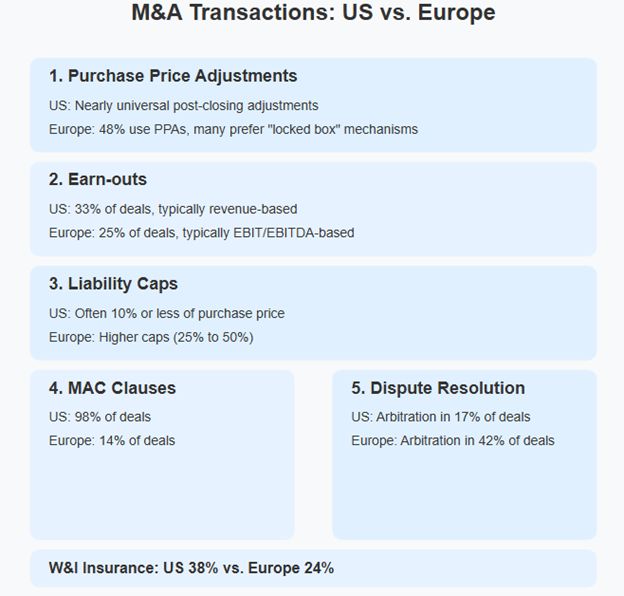
The infographic above provides a comprehensive overview of
the six key differences in M&A practices between the U.S. and
European markets. These points illustrate the fundamental
structural variations that deal teams must navigate when working
across borders.
1. Purchase Price Adjustments (PPA): Certainty vs.
Flexibility
In the U.S., PPAs are nearly universal. Buyers expect to be made
whole for gaps in working capital, shortfalls in cash in the bank,
and any remaining debt post-closing. It’s a well-oiled machine,
and most parties know the drill.
In Europe, it’s a different story. While PPAs are gaining
ground (found in less than half of all M&A deals per CMS), many
deals still rely on the “locked box” mechanism, where the
price is fixed based on a historical balance sheet, and the seller
warrants that there has been no leakage in value since the balance
sheet date. This approach offers price certainty but requires trust
and diligence.
U.S. clients doing deals in Europe should be open to lock box
structures, especially in competitive auctions. European clients
entering the U.S. should be ready for detailed post-closing
adjustments and the accounting gymnastics that come with them.
2. Earn-outs: A Tale of Two Metrics
Earn-outs are common in both markets, making up 33% of U.S.
deals and 25% of European ones. But the way they are structured
varies widely. In the U.S., revenue-based earn-outs are more
common, as opposed to Europe, where EBIT/EBITDA is king.
In tech and healthcare, where future performance is often
speculative, earn-outs can bridge valuation gaps. But they are also
a breeding ground for disputes.
Defining metrics clearly is table stakes, as is aligning
incentives and not underestimating the emotional toll of earn-out
negotiations, especially when founders are staying on board.
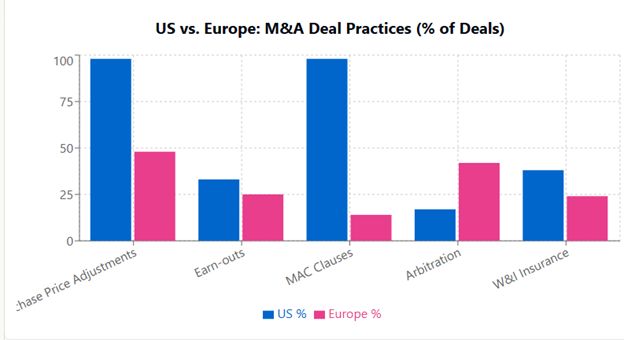
The chart above quantifies the prevalence of key M&A
practices in both markets. Note especially the dramatic difference
in MAC clause usage (98% in the U.S. versus just 14% in Europe) and
the inverse relationship in arbitration preference (17% U.S. versus
42% Europe). These statistical differences highlight the importance
of understanding regional norms when structuring cross-border
transactions.
3. Liability Caps: How Much Skin in the Game?
In the U.S., seller liability is often capped at 10% or less of
the purchase price, thanks to the widespread use of transactional,
or “rep and warranties” insurance (otherwise known as
“RWI”). In Europe, caps are higher, often 25% to 50%,
though RWI is catching up.
European sellers are more accustomed to bearing risk, while U.S.
sellers expect to shift it. This can lead to friction, so aligning
expectations early is key.
|
United States
|
Europe
|
|
|
Liability Cap Comparison
|
|
|
|
Legal Framework Differences
|
|
|
This interactive comparison illustrates the fundamental
differences in liability approaches and legal frameworks between
regions. Toggle between the tabs to explore how these differences
might impact deal structuring and negotiations. The higher
liability caps in Europe (25-50%) versus the U.S. (typically 10% or
less) reflect different risk allocation philosophies that must be
reconciled in cross-border transactions.
4. MAC Clauses: Rare in Europe, Routine in the U.S.
Material Adverse Change (MAC) clauses are standard in U.S. deals
and used in 98% of transactions. The idea is that between signing
and closing, the business has not suffered a MAC, and if it has,
the buyer does not have to close. Sometimes, it’s worded that
the business hasn’t suffered a MAC since the balance sheet
date. In Europe, however, they are rarefied air, appearing in only
14% of M&A deals, and often heavily qualified.
This can lead to surprises when U.S. buyers find no MAC clause
in a European deal, and European sellers may balk at the broad
language typical in U.S. agreements.
5. Dispute Resolution: Courts vs. Arbitration
Dispute resolution is where things really diverge. In the U.S.,
litigation is the default remedy, with arbitration used in only 17%
of deals. In Europe, the use of arbitration is much higher (42% of
deals in 2024), especially in cross-border transactions.
But there is a twist. 70% of European arbitration clauses apply
national rules, not international ones. That means a
“standard” arbitration clause in Germany may look very
different from one in France or the UK.
U.S. clients should be prepared for arbitration in Europe and
understand the local rules. European clients doing deals in the
U.S. should be ready for court proceedings and the discovery
process that comes with them.
6. Transactional Insurance: Growing, But Not Yet Global
RWI, or transactional insurance, is a game-changer. It smooths
negotiations, caps liability, and speeds up closings. In the U.S.,
it’s used in 38% of deals. In Europe, it’s at 24%, but
rising fast, especially in the UK and Germany.
I have seen RWI insurance unlock deals that would otherwise
stall over the scope of representations and warranties, indemnity
caps, or escrow mechanics. But it is not a silver bullet, so
underwriting diligence still matters.
Bridging the Gaps
Cross-border M&A is never just about the numbers. It’s
about culture, expectations, and communication. I have seen deals
that were super smart on paper fall apart because the
counterparties did not understand each other’s norms. And I
have seen unlikely partnerships thrive because they took the time
to bridge those gaps.
So, whether you’re a U.S. buyer eyeing a European AI
startup, or a European medtech platform bolting on a U.S. target,
remember that what is “market” depends on where you are.
When in doubt, ask someone who’s been on both sides of the
table.
The content of this article is intended to provide a general
guide to the subject matter. Specialist advice should be sought
about your specific circumstances.
link