





Shop with Heroes 2025
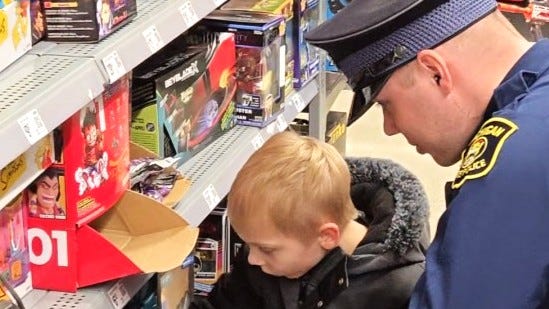
Law enforcement and first responders helped kids purchase Christmas presents for themselves and their families along with Toys for Tots Dec. 4.
An estimated 2.3 billion packages will be flying around the country during the 2025 holiday season, according to ShipMatrix. So even if 99.9% of deliveries are done correctly, 2.3 million packages could end up at the wrong address.
That’s a lot of Apple Watches, smokers and turduckens packed on dry ice that could end up at the wrong doorstep.
So what should you do if a package you didn’t order ends up in your hands?
The law is crystal clear in some situations and murky in others. It can depend on who delivered the package, who it is addressed to, what is inside and if you tried to get it to the intended recipient.
Is keeping a package meant for someone else a crime?
Receiving and taking possession of a misdelivered package are not illegal alone, but they can result in theft charges if you keep the package. The specifics of what you do and how the package was shipped matter.
The clearest case is when a package was addressed to someone else and delivered by the U.S. Postal Service to you. Federal law applies then, and keeping such a package is considered mail theft, according to the service. It is punishable by up to $250,000 in fines or up to five years in prison, according to legalclarity.org.
Things get a little murkier when the package is delivered by a private carrier. Federal laws about mail theft don’t seem to apply. And Colorado does not have a law written specifically regarding packages delivered by private companies such as Amazon, FedEx or UPS. However, the state’s theft laws generally should apply if you keep a package that was not intended for you unless you try to get it in the right hand.
What should I do if I receive a package addressed to someone else?
First, don’t open the package, which could make it harder to return.
Second, check the intended address. You might see it was supposed to go to a neighbor and you could simply choose to deliver it yourself.
If you don’t want to do that, you need to make a reasonable effort to get it in the right hands. If it was delivered in the mail, writing “return to sender” on it and setting it with outgoing mail is the simplest way.
If it was delivered by a private service, such as FedEx or Amazon’s network of carriers, it can be a little tougher. Contact either the carrier or the service the item was ordered through.
What happens if I can’t return the package?
If you make a reasonable effort to return the package, you might be able to keep it.
The U.S. Postal Service will collect packages misdelivered by its carriers and return or forward them. Private freight services likely will do the same, but online platforms such as Amazon using delivery contractors will not always try to collect the misdelivered item, especially if it is inexpensive. They sometimes say you can keep the item and they will ship a new one to the intended recipient.
Similarly, misdelivered meals and perishable food typically will not be picked up because of the risk of contamination while it was out of the courier’s possession.
Can I keep a package addressed to me that I did not order?
Yes, but you should be careful.
If you receive a package that is addressed for you, but you didn’t order it, you have the right to keep it without paying for it. The Federal Trade Commission says when a company sends you something you didn’t order that is addressed to you, they can’t later demand you return the item or pay for it.
Why should I report a misdelivered or unordered package?
First, contacting the private shipping service, seller or the post office helps you comply with laws requiring reasonable efforts to return a misdelivered package.
It’s also important because it helps the sales platform be aware of possible brushing scams that try to fraudulently boost a seller’s profile and sometimes capture personal information about customers.
What is ‘brushing’?
Brushing is where someone ships an item to a person that did not actually order it as part of a scam to improve the seller’s rating in a platform such as Amazon.
The seller or a collaborator sets up fictitious accounts that, as far as it looks to the selling platform, are different people typically buying expensive items, such as jewelry or computers.
In the scan, the seller actually ships low-value items, such as hair ties, to the different addresses, but to the selling platform, it looks like a series of sales of the high-end items to different individuals. The operators of the fictitious accounts then leave glowing reviews as verified buyers, helping drive up the seller’s rating and success in the platform’s algorithm.
In some cases, the supposed buyer’s profile uses the name of a real person at the address where the item would be delivered.
The Federal Bureau of Investigation has also warned about a variation on brushing scams where the unsolicited packages contain a QR code. After scanning the code, the recipients might be prompted to provide personal or financial information or to download malicious software.
These kinds of scams can be reported to the FBI.
Amazon also has a way to report them.
Arizona Republic staff writer Laura Daniella Sepulveda contributed to this report.
Nate Trela covers trending news in Colorado and Utah for the USA TODAY Network.
link