


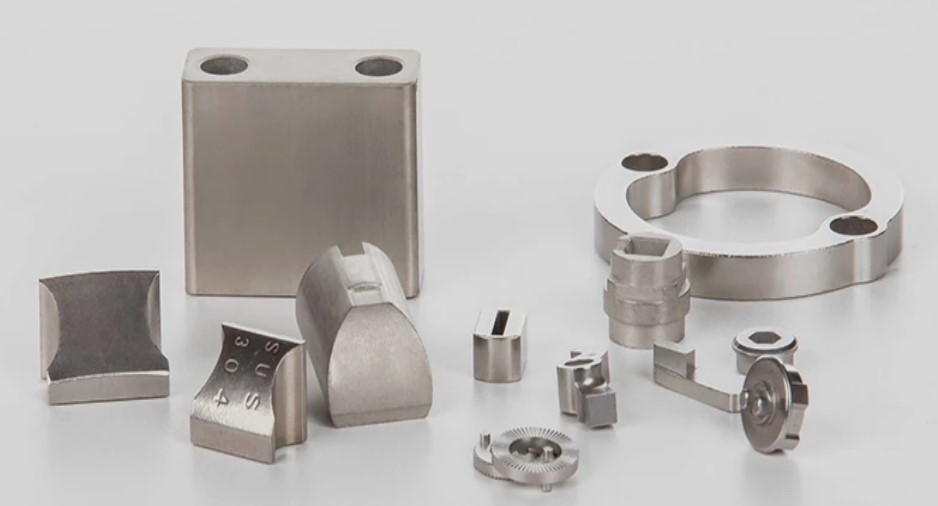
A MIM manufacturer does not occupy the most visible corner of the industrial world, but the work it performs underpins systems that millions of people rely upon every day. The surgical instruments used in operating theatres, the precision components inside firearms carried by law enforcement, the miniaturised hardware enabling the devices in people’s pockets: much of it originates in facilities where metal powder, binder, and heat are transformed through a carefully governed sequence into parts of remarkable complexity and consistency. To understand what separates a capable MIM manufacturer from the rest is to understand something important about how quality is built, not inspected, into manufactured products.
What Metal Injection Moulding Manufacturers Produce
The output of a metal injection moulding manufacturer is defined by the process’s particular strengths. Small parts. Complex geometries. High volumes. Tight tolerances. Materials with mechanical properties that match or approach those of wrought or machined equivalents. These characteristics place MIM firmly in a category of its own, distinct from casting, stamping, machining, or additive manufacturing, each of which handles a different region of the design and production space.
Parts produced by MIM manufacturers typically weigh between 0.1 and 100 grams. They may include internal features such as cross-holes, undercuts, and blind channels that would require multiple machining operations to produce conventionally, if they could be produced that way at all. The surface finish achievable directly from the mould is considerably better than sand casting and adequate for most functional applications without secondary operations.
The industries served reflect these capabilities:
Medical devices
- Surgical instrument jaws, endoscopic components, orthopaedic trial instruments, and drug delivery mechanisms, where biocompatible alloys and precise dimensions are non-negotiable
Automotive
- Turbocharger components, fuel system parts, transmission elements, and sensor housings that must perform reliably under thermal and mechanical stress
Consumer electronics
- Hinge assemblies, structural frames, connector components, and wearable device hardware where strength and miniaturisation must coexist
Firearms
- Trigger groups, safety mechanisms, and action components, one of the earliest and most established application areas for MIM technology
Aerospace and defence
- Actuator parts, precision brackets, and fastener components produced to exacting specifications in high-performance alloys
The Technical Capabilities That Distinguish Strong Producers
Not every facility that performs metal injection moulding operates at the same level of technical capability. The process involves a chain of interdependent stages, and weakness at any point propagates forward into the finished part. Evaluating a mim manufacturer means examining each stage with care.
Feedstock preparation is where quality either begins or is compromised. The metal powder must be of the correct particle size distribution, typically below 20 microns for most applications. The binder system must be uniformly mixed, with no agglomeration that would create voids or surface defects in the moulded part. Capable producers either manufacture their own feedstock under controlled conditions or source it from qualified suppliers with documented material specifications.
Tooling quality determines dimensional repeatability. A well-designed mould accounts for the predictable but significant linear shrinkage of 15 to 20 per cent that occurs during sintering, calculating cavity dimensions to yield the correct final geometry. Toolmakers working with experienced MIM component manufacturers understand that the tolerance chain runs from feedstock through mould through sintering furnace, and that each stage must be controlled if the final part is to meet its drawing.
Sintering is where the transformation completes. The debound green part is fired at temperatures approaching but not reaching the melting point of the alloy, typically between 1,200 and 1,400 degrees Celsius for stainless steels, under a controlled atmosphere that prevents oxidation and supports the densification required to achieve target mechanical properties. Furnace calibration, atmosphere management, and cycle documentation are the marks of a serious operation.
Quality Standards and Certifications
A MIM manufacturer operating in regulated supply chains is expected to hold and maintain formal quality certifications that provide customers with documented assurance about the management system governing production.
The key standards include:
ISO 9001
- The baseline quality management system standard applicable across manufacturing industries
ISO 13485
- Required for manufacturers supplying components into medical device supply chains, covering design controls, traceability, and post-market quality activities
IATF 16949
- The automotive sector quality management standard applying additional requirements around statistical process control, measurement system analysis, and production part approval processes
AS9100
- The aerospace and defence quality standard incorporating stringent configuration management and first article inspection requirements
ISO 14001
- Increasingly required by customers with sustainability commitments, governing environmental management system performance
Singapore’s MIM manufacturing sector has built a reputation for operating to the upper end of these requirements. Manufacturers there hold multiple concurrent certifications, serving medical, automotive, and electronics customers from facilities that are regularly audited by international notified bodies and customer quality teams. Singapore’s position as a regional manufacturing hub, supported by its infrastructure, regulatory framework, and technically trained workforce, has made it a reference point for MIM component quality across Asia Pacific supply chains.
Evaluating a Manufacturing Partner
For procurement teams and design engineers assessing potential suppliers, the evaluation criteria for a metal injection moulding manufacturer extend well beyond price and lead time. The questions that matter most concern process control depth, quality system maturity, and demonstrated experience with the specific material and geometry class required.
Does the producer hold the certifications relevant to your supply chain? What is its non-conformance rate and CAPA closure history? Can it demonstrate sintering furnace calibration records and incoming powder inspection data? These are not bureaucratic questions. They are the mechanisms through which a customer gains confidence that the parts arriving in their facility will perform as specified, production run after production run.
The value of choosing the right partner compounds over time. Qualification costs are significant. Supply chain disruptions are expensive. A mim manufacturer with the capability, the certifications, and the quality culture to sustain consistent output is an asset that rewards the effort invested in finding one.