
Anti-ESG Shareholder Proposals In 2025 – Executive Remuneration

Companies and investors use information related to
environmental, social or governance (“ESG”) factors to
provide a company-wide view of sustainability and other priorities.
This includes how the company discloses, reacts to and manages
ESG-related risks and policies, such as, for example, risks related
to carbon emissions, as well as policies addressing diversity,
shareholder rights and corporate social responsibility. These
topics are often the subject of shareholder proposals advocating
additional disclosure or policies in furtherance of ESG-related
goals. In contrast, “anti-ESG proposals” are generally
critical of, or question the value of, company policies or
initiatives related to these topics. As of the midpoint of the 2025
proxy season, “anti-ESG” proposals have become more
common, a trend mirroring that seen in recent years. In addition,
proponents that, in past proxy seasons, submitted proposals on
clearly anti-ESG topics, such as opposition to climate change-based
initiatives, are now submitting proposals on a broader array of
topics.
As of June 3, 2025, conservative proponents that traditionally
submitted anti-ESG proposals had submitted an aggregate of
approximately 120 shareholder proposals. This is approximately the
same number of proposals as were submitted by the same group of
proponents during the 2024 proxy season. Approximately 50 (45%) of
the 2025 proposals have been voted on to date and, notably, just as
in 2024, none of these proposals has received a majority
shareholder vote. About 15% have yet to be voted on, while the
remaining approximately 40% were not subject to a shareholder vote,
generally because they were withdrawn by the proponent or the
company was permitted to omit the proposal via the U.S. Securities
and Exchange Commission’s (the “SEC”) no-action
request process. Support levels for proposals ranged from a low of
0.20% to a high of almost 12%, with a median support level of 1.4%.
This is similar to the low of 0.03% support received in 2023;
however, proposals received as high as approximately 36% support in
2024. Notably, however, at the midpoint of the 2024 proxy season,
anti-ESG proposals had received a median support level of
approximately 1.5%, showing that support for these proposals
overall remains steadily low year over year.
No-Action Requests Related to Anti-ESG Proposals
Pursuant to Rule 14a-8 under the Securities Exchange Act of
1934, as amended (the “Exchange Act”), the SEC agrees
that it will not take action against companies that omit
shareholder proposals that meet certain criteria detailed in Rule
14a-8. To date, in the 2025 proxy season, companies submitted
approximately 55 no-action requests for proposals received from
proponents that typical submit anti-ESG proposals. This represents
a significant increase from the approximately 40 requests submitted
to the SEC staff (the “Staff”) during the 2024 proxy
season.
So far in 2025, the Staff has agreed that it would take no
action in connection with the omission of 30 such proposals, or
slightly more than half, an increase from the 40% of requests on
which the Staff agreed to take no action in 2024. In 2025, these
proposals spanned a wide-cross-section of issues, with multiple
proposals touching on traditional anti-ESG topics such as (i)
greenhouse gas (“GHG”) emissions, (ii) risks related to
religious discrimination, (iii) the use of diversity, equity and
inclusion (“DEI”) goals in setting executive compensation
and (iv) requests that companies consider abolishing their DEI
policies and goals. However, multiple proposals requested
assessments by a company’s board of directors “to
determine if adding Bitcoin to the company’s treasury is in the
best long-term interests of shareholders.” Bitcoin was the
subject of only one anti-ESG proponent shareholder proposal in
2024, which, since this topic is outside of those generally
considered to be anti-ESG, might show that proposal proponents are
expanding their interests.
The approximately 25 proposals that the Staff declined to omit
spanned a similar cross-section of issues, perhaps evidencing that
the Staff considers the unique facts and circumstances of each
company in determining whether to grant a no-action request. These
topics include requests that companies (i) consider abolishing DEI
programs and goals, (ii) revisit the use of DEI goals in setting
executive compensation, (iii) report on how their charitable
contributions “impact risks related to discrimination against
individuals based on their speech or religious exercise” and
(iv) report on oversight of “risks related to discrimination
against ad buyers and sellers based on their political or religious
status or views.” Interestingly, almost all of these proposals
were confined to traditional anti-ESG topics, with a strong leaning
toward proposals related to potential discrimination regarding free
speech and/or religious exercise. The proposals that have been
voted on received favorable votes ranging from 0.20% to almost 9%;
however, all but one proposal received support of approximately 2%
or less.
Topics and Trends in Anti-ESG Proposals
A majority of the anti-ESG proposals voted on so far in 2025
deal with topics thought to be traditionally anti-ESG, such as
challenging DEI programs or opposing efforts to mitigate climate
change. The proposals can be categorized as follows:
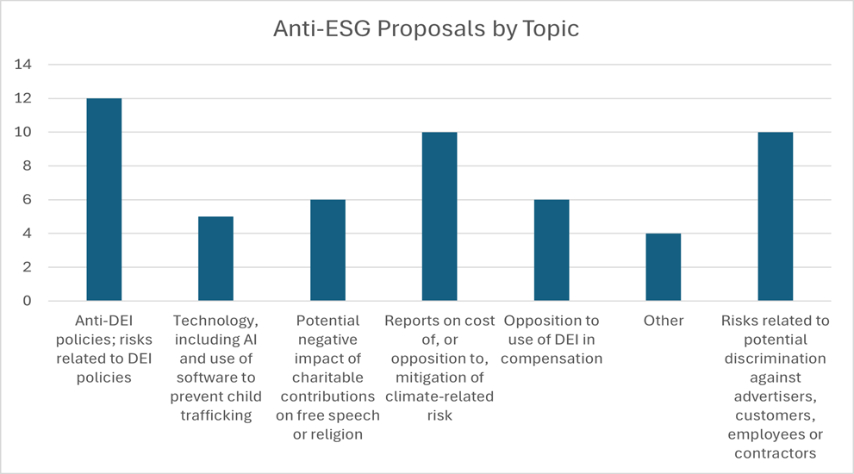
The proposals can be further cataloged as follows:
Anti-DEI Proposals
Collectively, proposals touching on DEI, such as (i) opposing
the use of DEI in setting executive compensation, (ii) requesting
that companies consider abolishing DEI policies or (iii) asking for
reports on the risks of such policies, constitute more than 40% of
the anti-ESG proposals voted on to date in 2025. These proposals
received a maximum of around 3% of shareholder support. Anti-DEI
proposals were less common in 2024, with only two proposals
opposing the use of DEI in executive compensation, and an
additional approximately 10 proposals asking for reporting topics
such as the “potential risks associated with omitting
“viewpoint” and “ideology” from its written
equal employment opportunity policy” or the “impacts of
DEI policies on civil rights, non-discrimination and return to
merit, and the impacts of those issues on the Company’s
business.” Anti-DEI proposals in 2025 tended to be more
strongly worded, including clear requests that companies consider
abolishing DEI policies altogether, perhaps reflecting the current
political climate in the United States. In both years, to date, all
proposals received low levels of shareholder support.
Proposals Regarding Free Speech and Religious
Exercise
A large number of anti-ESG proposals in both 2024 and 2025
focused on the views expressed and the policy positions taken by
companies, officers and directors, and the potential impact of such
views and actions on the company’s financial condition.
Proposals seemed to focus on two main areas: risk of negative
impacts of certain charitable giving and risks of discrimination
via policy or action.
Charitable Giving
In both 2024 and 2025, a number of anti-ESG proposals centered
on charitable giving. In 2025 to date, approximately five companies
received a proposal requesting an analysis of how a company’s
“contributions impact its risks related to discrimination
against individuals based on their speech or religious
exercise.” In addition, a very small number of proponents
requested the creation of a board committee to oversee and/or a
report on the impact of a company’s policies and/or charitable
giving on its financial sustainability, generally alleging that
companies contribute to organizations that “attack free speech
and religious freedoms.” However, in 2024, approximately 12
companies received an almost identical proposal to the latter,
supported, at least in some cases, by the statement that
“company bottom-lines, and therefore value to shareholders,
drop when companies take overtly political and divisive positions
that alienate consumers.” Taken together, this may demonstrate
that investors’ interest in charitable giving continues to
evolve. In 2024 and to date in 2025, these proposals all received
low levels of shareholder support.
Risks of Discrimination via Policy or Action
In 2025 to date, approximately 20% of the proposals voted on to
date dealt with risks related to discrimination based on the
exercise of free speech or religion. Slightly less than 10
proposals asked for reports on how a company “oversees risks
related to discrimination against ad buyers and sellers based on
their political or religious status or views,” alleging
censorship “for expressing disfavored political and religious
viewpoints.” Additionally, a small number of proposals
requested a report on risks related to religious or other
discrimination against employees, or discrimination against
customers.
In 2024, proposals related to discrimination also constituted
around 20% of the anti-ESG proposals subject to a shareholder vote.
However, almost all of the 2024 proposals specifically asked for
companies to issue reports on risks related to discrimination
against individuals, customers and/or employees based on factors
including religion, and/or whether this may impact individuals’
exercise of their civil rights or the company’s business. The
2025 proposals, detailed above, were more varied and used stronger
language, including references to “censorship” of certain
views. As yet, none of these proposals in either year have received
more than approximately 2% shareholder support.
Proposals Relating to Climate-Based Risk
In 2025 to date, almost 20% of anti-ESG proposals opposed
company responses to climate-based risks, such as requests for
reports on costs, benefits and/or risks arising from voluntary
environmental activities, such as carbon-reduction commitments, or
requests to remove all GHG emissions reduction targets. The
overwhelming majority of these proposals that have been voted on
received less than 3% shareholder support.
In 2024, an almost equivalent percentage of anti-ESG proposals
on which shareholders voted were related to climate-based risk,
showing ongoing interest in this topic, perhaps especially in light
of the SEC’s adoption of rules regarding the disclosure of
climate-based risk.1 However, the rules became subject
to litigation almost immediately after adoption, and on February
11, 2025, then Acting SEC Chair Mark Uyeda publicly stated his
request that the Eighth Circuit Court of Appeals postpone arguments
in the case.2 Subsequently, on March 27, 2025, the SEC
voted to end its defense of the rules, such that it is difficult to
predict whether the number of shareholder proposals focused on
climate-based risk will remain constant in 2026.3
Importantly, all but one of the 2024 proposals received
approximately 3% support or less, in line with overall low support
in 2025.
Proposals About Technology and Artificial
Intelligence
In terms of technology-focused proposals, even anti-ESG
proposals are not immune to the growing focus on artificial
intelligence (“AI”). The same proposal, requesting a
report assessing the risks posed to each company and the public due
to the real or potential improper use of data in developing,
training, and deploying AI offerings, as well as the steps taken to
mitigate these risks, received high levels of shareholder support
at several different companies, averaging around 10%. In 2024,
anti-ESG proponents submitted a single identical proposal,
receiving approximately 35% support, the highest of any anti-ESG
proponent proposal that year. We will have to wait to see if the
increasing frequency of AI-focused proposals, outside of the topics
generally addressed by conservative proponents, continues in future
years, but it seems clear from the relatively large shareholder
support on which companies and investors will continue to
focus.
Corporate Governance Proposals
In 2024, a small number of anti-ESG proponents submitted
proposals related to corporate governance topics. Examples include
a prohibition against directors simultaneously sitting on the
boards of two or more other companies and two or more non-corporate
organizations, and proposals mandating a separate chair of the
board and chief executive officer. However, we did not find a
significant number of corporate governance-related proposals from
anti-ESG proponents in 2025, so it will be interesting to see what
happens in 2026.
Key Takeaways
So far, the 2025 proxy season has demonstrated that, in spite of
a seeming increase in public anti-ESG sentiment and anti-ESG
shareholder proposals, support for anti-ESG measures remains low.
Notwithstanding, anti-ESG proponents appear to be broadening their
agendas—from familiar attacks on DEI initiatives and
climate-related targets to newer demands addressing political or
religious discrimination, cryptocurrency treasury strategies,
artificial intelligence oversight and, to a lesser extent,
traditional governance reforms—thereby compelling issuers to
respond to an ever-wider array of proposals. Companies were more
aggressive in seeking SEC no-action relief this year, and, overall,
the Staff was more willing to grant it. However, roughly half of
challenged proposals nevertheless survived.
The guidance in SLB 14M seems to have made it slightly easier
for companies to exclude shareholder proposals that do not directly
tie a significant policy issue to the company’s business;
however, the Staff’s decision-making regarding no-action
requests remains somewhat opaque. In light of this, boards and
management teams should continue to refine their
shareholder-engagement protocols, maintain clear rationales for
ESG-related policies, and ensure that disclosure controls are
calibrated to address both pro- and anti-ESG scrutiny, recognizing
that while anti-ESG activism shows little sign of swaying the
broader investor base, it will persist as a vocal and procedurally
sophisticated force in the proxy landscape.
Footnotes
1 See back)
2 See back)
3 See back)
Originally published by Harvard Law School Forum on Corporate
Governance
Visit us at mayerbrown.com
Mayer Brown is a global services provider comprising
associated legal practices that are separate entities, including
Mayer Brown LLP (Illinois, USA), Mayer Brown International LLP
(England & Wales), Mayer Brown (a Hong Kong partnership) and
Tauil & Chequer Advogados (a Brazilian law partnership) and
non-legal service providers, which provide consultancy services
(collectively, the “Mayer Brown Practices”). The Mayer
Brown Practices are established in various jurisdictions and may be
a legal person or a partnership. PK Wong & Nair LLC
(“PKWN”) is the constituent Singapore law practice of our
licensed joint law venture in Singapore, Mayer Brown PK Wong &
Nair Pte. Ltd. Details of the individual Mayer Brown Practices and
PKWN can be found in the Legal Notices section of our website.
“Mayer Brown” and the Mayer Brown logo are the trademarks
of Mayer Brown.
© Copyright 2025. The Mayer Brown Practices. All rights
reserved.
This Mayer Brown article provides information and
comments on legal issues and developments of interest. The
foregoing is not a comprehensive treatment of the subject matter
covered and is not intended to provide legal advice. Readers should
seek specific legal advice before taking any action with respect to
the matters discussed herein.
link