
Fueling Private Equity With Operations And The Office Of The CFO – Corporate and Company Law

Riveron are most popular:
- within Law Department Performance, Environment and Energy and Natural Resources topic(s)
- with readers working within the Technology industries
A version of these insights first appeared in Forbes Finance Council.
Private equity leaders are increasingly recognizing a need to
maximize growth in portfolio company operations. The past half
decade of unique macroeconomic circumstances—from COVID to
interest rate policies—has limited access to traditional
financial engineering methods to drive returns. The current climate
is pushing many private equity firms to revisit their strategies
and focus on fostering operational excellence from the inside
out.
“While many PE firms have historically built value by
acquiring and integrating companies, that deal-focused strategy is
proving less effective today. Now, many sponsors are finding they
must pivot their focus to driving operational improvements… and
empowering the office of the CFO.”
While many private equity firms have historically built value by
acquiring and integrating companies, that deal-focused strategy is
proving less effective today. Now, many sponsors are finding they
must pivot their focus to driving operational improvements within
their portfolio companies, particularly by strengthening and
empowering the office of the CFO, an area often
overlooked in past approaches. In today’s environment, private
equity-backed organizations can thrive by moving beyond
surface-level optimization and taking a deliberate, hands-on
approach to improving portfolio company operations. This includes
everything from commercial effectiveness and supply chain
optimization to making lasting improvements within the office of
the CFO.
Drawing on my experience advising private equity clients,
I’ve seen firsthand how transforming the finance function can
unlock meaningful performance gains across a business. By
modernizing systems, improving data visibility, and empowering
finance leaders to shift from recordkeeping to strategic guidance,
sponsors can accelerate value creation in measurable ways. In a
market where every dollar counts, the office of the CFO has
reemerged as a critical lever for driving long-term growth and
differentiation.
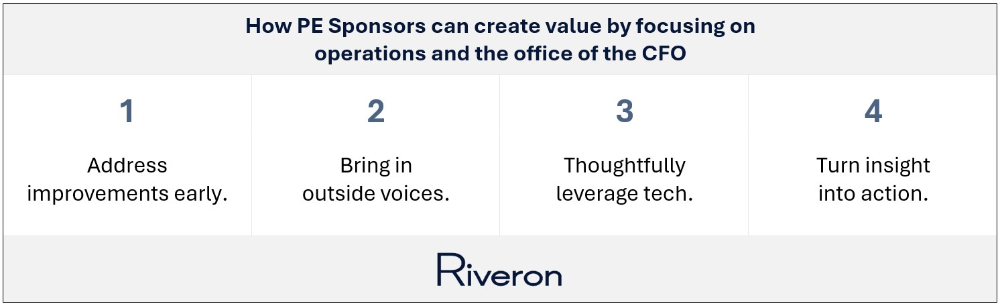
Address improvements early
Long before private equity professionals make an offer on a
potential investment, they conduct extensive research, verify
investment potential, and identify preliminary risks. However, the
rigor of the deal process and road to close often leaves management
teams fatigued and reluctant to make significant changes out of the
gate. Failed sales processes across the private equity landscape
are a glaring indication of the industry’s need to adapt.
Despite the potential lift surrounding people, process, and
technological change, leaning into early action maximizes returns
on the back end and reduces the cost of these efforts in the long
run.
Some of the most persistent operational gaps in PE-owned
companies present themselves within the office of the CFO, placing
accounting, finance, and technology functions at risk. Many
portfolio companies cycle through CFOs or other financial leaders
during a hold period, especially in first equity sponsor scenarios.
Even if progress is made under one leader, it is often lost in the
chaos of persistent organizational upheaval. These challenges are
especially pronounced in smaller businesses, where early-stage
success often deprioritizes establishing scalable, foundational
infrastructure. It is easy to prioritize growth at the expense of
infrastructure reinvestment in a portfolio company’s early
days, but acknowledging and purposefully investing in strong
financial leadership during the hold period provides runway to
accelerate growth and, more importantly, maximize exit value.
Bring in outside voices
Private equity firms often expect CFOs to fill multiple roles.
These “jack-of-all-trades” expectations include
simultaneously being a chief accounting officer, vice president of
FP&A, chief information officer, chief technology officer,
chief corporate development officer, and more. Admitting that one
size does not fit all and leaning into external expertise paves the
way for better tech advancement. Seeking counsel also helps avoid
bias toward a potentially ineffective long-term solution.
Third-party advisors cut through internal bias by evaluating
situations objectively, using clear business requirements,
current-state infrastructure, and the deal thesis as their guide.
They can also support accurate budget setting early, preventing
mismanaged expectations that lead to massive cost overruns and
impact job security. Most importantly, an outside advisor limits
the risk of selecting the wrong solution or including unnecessary
add-ons and ensures alignment with stakeholder interests. Nearly
half of private equity technology engagements within the office of
the CFO I’ve seen in the past five years have been to fix a
suboptimal selection or implementation process, compared to
supporting a client with getting it right the first time.
Thoughtfully leverage tech
Performance visibility plays an increasingly important role in
value creation exercises. Much like a doctor requires accurate,
state-of-the-art equipment to evaluate a patient’s physical
well-being, CFOs and controllers need real-time, reliable data to
monitor working capital, forecast cash flow and ensure compliance.
While people and processes remain critical, effective technology enhancement is the quickest path to
unlocking value.
Too often, companies rush into technological upgrades, resulting
in underestimated costs and tools that don’t align with the
company’s structure or reporting needs. By engaging either
operating partners or vetted third-party advisors early in the
process, sponsors and management teams can avoid missteps and
reduce distractions for finance leaders. Ultimately, modern finance
technology empowers private equity-owned companies to operate more
efficiently and strategically day to day. For example, our team
helped one private-equity backed organization implement an ERP that
was right-sized for the company’s operations. Through this
proactive effort, the company streamlined its procure-to-pay and
accounts payable processes, which eliminated its onerous legacy
system and enabled leadership to access timely, accurate data. This
is just one of many examples that show how investing in automation,
planning, and reporting tools allows finance leaders to shift their
team’s focus from lower-value work to supporting value
creation.
Turn insight into action
In today’s market of high interest rates and prolonged exit
timelines, execution is everything. I’ve long heard the saying,
“A consultant is someone who borrows your watch to tell you
the time—and then keeps your watch.” It’s a telling
cliché, especially as clients seek hands-on partners.
The private equity firms and portfolio companies that outperform
others will build a culture of operational rigor, address needs
early, leverage helpful voices, and lead change effectively. This
is especially true in the office of the CFO, where timely access to
data, accurate forecasting, and strong internal controls directly
influence a company’s ability to grow and scale. Finance
leaders who pair insight with action can become powerful value
creators. And the private equity sponsors who enable that
transformation will gain a durable edge in an increasingly
competitive market.
The content of this article is intended to provide a general
guide to the subject matter. Specialist advice should be sought
about your specific circumstances.
link