
Neurodivergent Services M&A Market – Corporate and Company Law

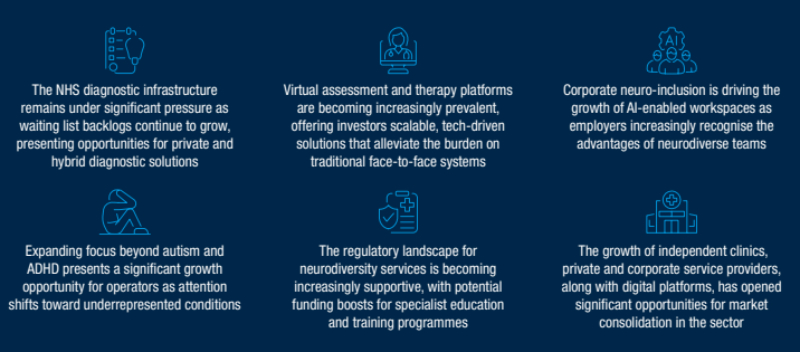
Neurodiversity Services market overview
Neurodiversity is an umbrella term that includes a range of
neurological conditions that include ADHD, autism, dyspraxia,
dyslexia and Tourette’s syndrome. These conditions lead to
differences in the way people receive, process, and respond to
information about the world. Core neurodiversity services span
diagnostic assessments, therapies and medical management, workplace
assistive technologies, educational assistance and wider community
and social support. Not long ago, the neurodiversity services
market was virtually non-existent, with few resources or support
networks available to meet the needs of neurodivergent
individuals.
Only in recent years has awareness translated into tangible
services, creating an industry rife with growth potential.
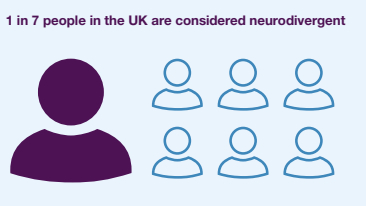
Neurodivergent individuals represent around 15% of the UK
population. This share of the population has been identified
following a surge in diagnoses, with Autism diagnoses alone rising
by 787% between 1998-2018.2 Recognition of these
conditions point to a broad, lifelong need for specialised services
across health, education and social care. The identification of
systemic barriers in employment against those with neurodivergent
conditions has prompted a shift from service models designed for
neurotypical populations to neuro-inclusive frameworks. These new
frameworks offer adapted diagnostic pathways, accessible
communication formats, as well as workplace accommodations.
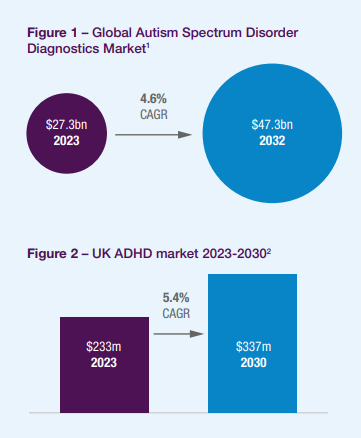
The UK Government has established plans in place in order to try
and tackle some of the systemic barriers such as the National
Strategy for Autistic Children, Young People and Adults. However,
already struggling services—particularly within the
NHS—have left many families facing long wait lists and
limited support, creating space for the private sector to step in.
As both awareness and demand escalate, the neurodivergent services
market is poised for continued expansion.
M&A Summary
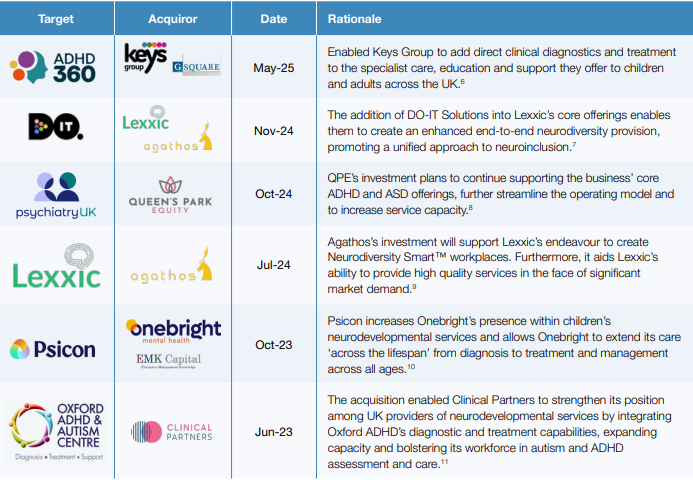
Recent M&A in the neurodiversity services sector has been
driven by the need to expand diagnostic and treatment capacity,
diversify service offerings and create scalable platforms capable
of meeting rising demand.
Acquirers are typically larger healthcare groups or private
equity-backed platforms pursuing buy-and-build strategies, with
transactions often aimed at integrating smaller, specialist clinics
and service providers into broader networks. This consolidation is
not only about increasing capacity but also about professionalising
fragmented markets, introducing more consistent governance and
embedding digital pathways to improve efficiency and patient
access.
The Covid-19 Pandemic further accelerated demand for remote
assessments and digital therapies,5 highlighting the
scalability of online delivery and making established digital
platforms attractive acquisition targets for larger groups.
Changes in the NHS procurement regime are also pushing providers
toward greater scale, with organisations that have robust systems
better placed to secure long-term contracts. Looking ahead, we can
expect continued activity as investors target resilient, socially
impactful assets and operators look to accelerate growth, with
acquisitions increasingly favoured over slower organic
expansion.
Changes in the NHS procurement regime are also pushing providers
toward greater scale.
Recent Neurodivergent Services transactions
Additional sector activity and recent
innovations
Recent investments in the sector have significantly accelerated
the development and implementation of systems designed to support
neurodiverse individuals.
Educational assistance has emerged as a particularly dynamic
sub-sector in recent years, with frequent M&A activity and
funding fuelling innovation. For instance, in November 2022,
multiple VC investors backed Healios, a leading private provider of
children’s mental health and neurodevelopmental services.
Healios focused on creating new assessment and intervention
programmes while advancing machine learning, data science and
clinical research.
In April 2023, Cognassist secured a £4 million investment
from Gresham House Ventures. This funding is enabled Cognassist to
further develop its SaaS platform, which identifies and supports
individuals with learning needs. The company is now working to
expand into the enterprise market while maintaining its strong
presence in the education sector.
More recently, in April 2025, Outcomes First Group (OFG)
acquired Tute Education. This acquisition integrates Tute’s
purpose-built online platform, covering Key Stages 1-5, with
OFG’s commitment to delivering high-quality, personalised
education. The move allows OFG to broaden its reach, providing more
young people with tailored and flexible learning opportunities.
These developments underscore a sector experiencing rapid
innovation and growth, with increasing momentum behind companies
that are transforming how neurodiverse needs are addressed and
supported.
Sector Outlook
The expansive growth of the Neurodivergent Services market can
be attributed to rising awareness, policy changes and crucially the
structural inefficiencies of the NHS. A key catalyst has been the
NHS Right to Choose (RTC) scheme which grants patients the legal
right in England to select any qualified NHS-contracted provider
for assessments for a neurological condition like ADHD or
Autism.
This scheme has enabled independent operators such as:
Psychiatry UK, Psicon, and ADHD 360 to offer faster pathways for
patients either through the NHS scheme or privately. It should be
noted that some of these clinics have been involved in
controversies regarding false positive diagnoses,12
however they claim efforts have been made to rectify this issue
since.
However, recent announcements from the UK government has
suggested some potential short-term headwinds. Proposed reform to
the RTC scheme could give local Integrated Care Boards (ICBs) the
power to block referrals to independent providers. Furthermore,
some NHS bodies are seeking to impose ‘artificial’ minimum
waiting times in order to manage budgets which may delay treatments
and reduce private sector throughput.
Despite these potential obstacles, the medium to long-term
outlook for the Neurodivergent Services sector remains strong.
Waitlists continue to balloon from 17,40013 people
waiting for an ADHD assessment in 2019 to 549,000 waiting in
2025.14 Demand continues to grow and government policy
reflects the dual challenge of reducing NHS spending while
addressing extensive waiting lists. This creates a balancing act,
where current measures may prioritise budget control, but the
persistent rise in demand signals strong growth potential for the
sector in the longer term.
A culmination of growing corporate and educational focus on
neuro-inclusivity, the increasing pressures on an overburdened NHS,
as well as a strong pipeline of innovation and investment, the
Neurodivergent Services sector retains significant headroom to grow
beyond some potential regulatory induced volatility in the
short-term.
Footnotes
1 “Neurodiversity” NHS England, June 7,
2024.
2 Ginny Russell et al, “Time trends in autism
diagnosis over 20 years: a UK population-based cohort study”
The Journal of Child Psychology and Psychiatry 63, no. 6 (2022):
674.
3 “Autism Spectrum Disorder Market” Zion Market
Research, February 2024.
4 “UK Attention Deficit Hyperactivity Disorder
Market Size and Outlook” Grandview Research, 2024.
5 Report of the independent ADHD Taskforce: Part 1, NHS
England June 20, 2025.
6 “Keys Group Welcomes ADHD 360 to the Family in
Exciting new Acquisition” Keys Group, May 20, 2025
7 “Agathos supports Lexxic to acquire Do-IT
Solutions” Agathos, November 4, 2024.
8 “UK: QPE invests in UK’s leading provider of
digital psychiatry services” investors in healthcare November
1, 2024.
9 “Agathos backs management buy-out of Lexxic”
Agathos July 8, 2024.
10 “EMK Capital-backed Onebright acquires
Psicon” RealDeals October 5, 2023.
11 “Clinical Partners buys Oxford ADHD and Autism
Centre” Health & Protection, June 26, 2023.
12 “ADHD: Private clinics exposed by BBC undercover
investigation” BBC News, May 15, 2023.
13 “ADHD surge driven by rising awareness rather
than more cases” Financial Times, 4 June, 2025
14 Amy Borret, “Almost 2.5mn people in England
estimated to have ADHD” Financial Times, May 29,
2025
Originally published 29 September 2025
The content of this article is intended to provide a general
guide to the subject matter. Specialist advice should be sought
about your specific circumstances.
link