Southern Company’s fossil fuel gamble

News | December 12, 2025
The electric and gas utility behemoth is betting big on data centers. The only guarantee is a dirtier South
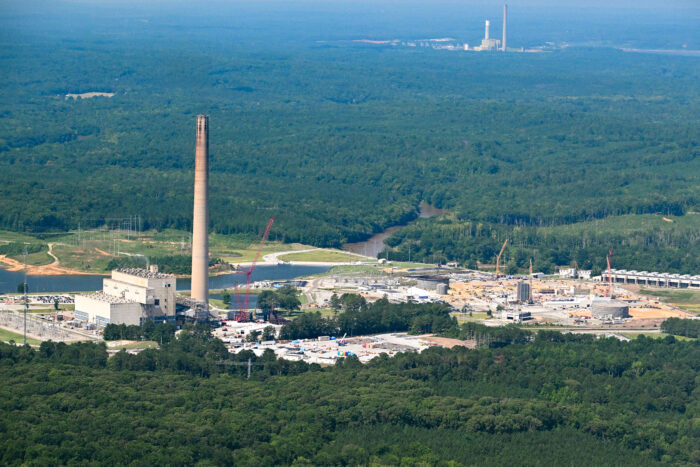
New methane gas burning units under construction Georgia Power’s Plant Yates in Coweta County (David Tulis and Southwings)
From the beaches of Gulfport, Mississippi to Savannah, Georgia’s storied River Street, more than 4 million customers across the South pay a Southern Company electric utility to keep their lights on. And if you’re a residential customer in one of Southern Company’s three monopoly utility’s territories—Alabama Power, Georgia Power, and Mississippi Power—you can’t choose where you buy your electricity from.
But publicly traded companies often work in the best interest of their shareholders, not your health, environment, or pocketbook. Now Southern Company is building methane gas pipelines and power plants, and keeping dirty coal burning units alive in the hopes of cashing in on data centers interested in coming to the South, even though much of projected data center demand is speculative — if not outright implausible. It’s a high stakes gamble with customers’ bills and health on the line.
“Southern Company does business at every level of the supply chain. It makes big money building big power plants, not helping its customers reduce energy use or use renewables,” said Bob Sherrier, a staff attorney in SELC’s Georgia office. “Residential customers don’t get to shop around for electricity. And if the data center boom stumbles regular Georgians will be on the hook.”
Rolling the dice on data centers
Southern Company’s power plants work together to send electricity to its monopoly utilities’ customers. Now the company’s coal and methane gas burning power plants across the South previously called “uneconomical” are staying online in hopes to power data centers interested in Georgia.
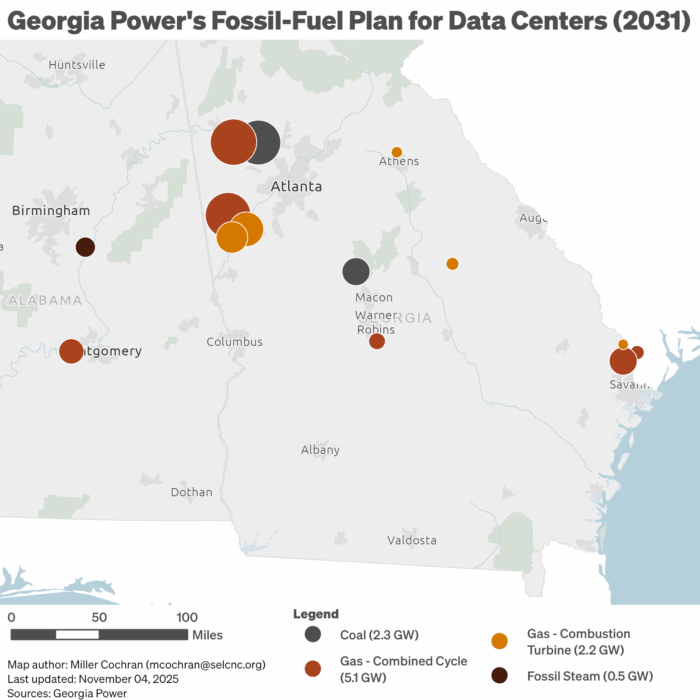
Georgia Power is asking the Georgia Public Service Commission to approve adding nearly 10 gigawatts to its grid to meet supposed data center demand. That’s about five Hoover Dams worth of power. Fossil fuels would produce most of that power, including five brand new methane gas burning units across the state. Another three methane gas burning units are already under construction at Georgia Power’s Plant Yates in Coweta County, Georgia because of projected data center demand.
The cost to build new power plants, and the fuel burned there, are all passed down to customers. Georgia Power’s customers have endured six bill hikes since 2023, so they are already feeling the pain of past project overruns and sometimes expensive fossil fuels.
Alabama Power’s residential customers pay the highest electric bills in the country on average, according to an analysis by Inside Climate News. Residents fear more hyperscale data centers are on the way. A proposed data center outside Birmingham would use about the same amount of energy as ten times the usage of all the city’s residents.
Alabama Power just purchased an existing methane gas power plant to meet growing demand, including data centers. Retirement for the nation’s largest greenhouse gas emitter, the company’s coal-burning Plant Miller north of Birmingham could be more than a decade away.
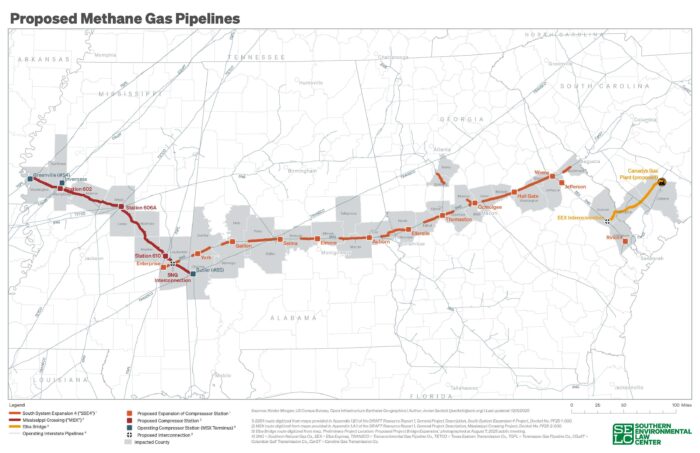
To help bring methane gas to new power plants, Southern Company and others are asking federal regulators to greenlight a nearly 500-mile of new methane pipeline that would create a fossil fuel superhighway across Mississippi, Alabama and Georgia.
Pipeline to the past threatens the South

Southern Natural Gas Company, owned by Southern Company and Kinder Morgan, is among the corporations asking the Federal Energy Regulatory Commission (FERC) for approval of massive pipeline projects that includes 300 miles of additional pipe to an existing line across Alabama and Georgia and 200 miles of new pipe across Mississippi. The project would also upgrade 14 polluting compressor stations, and build three new ones, pushing methane across three states.
“We already have pipelines here in the Black Belt. They didn’t create economic prosperity for my community—just put us at risk,” said Portia Shepherd, executive director of Black Belt Women Rising. “Now they want to add more gas pipes across Alabama, risking our health to help power datacenters in Georgia?
Shepherd’s group focuses on addressing inequities across Alabama’s Black Belt, including the region’s history of environmental injustice. That history includes a 2022 methane gas pipeline explosion in Perry County, Alabama.
“Families were forced to evacuate their homes after a pipeline explosion. They left everything behind, weren’t told when it was safe to return,” Shepherd said. “This is what happens when profit is prioritized over people.”
Aside from the safety and air pollution risks, the proposed pipeline path crosses 11 rivers and over 1,000 sub watersheds in Alabama and Georgia alone. If FERC approves the project, the pipeline companies can use eminent domain to seize land for the project.
‘Bad for business’
What’s good for electric customers, like programs to use energy more efficiently and residential solar, doesn’t usually make monopoly utilities a lot of money. For an energy conglomerate like Southern Company, fossil fuels are big business. Southern Company partially owns several pipelines that bring methane gas to power plants that Southern Company builds. Then, a Southern Company utility sells that electricity to customers who don’t get to choose their energy provider.
“Southern Company enjoys record breaking profits year over year, but to grow that bottom line they expect everyday folks to endure dirtier air, more severe weather, and higher power bills,” said Sherrier. “Federal and state regulators, like public service commissions and FERC, must hold companies like Southern Company accountable. Our communities and the next generation deserve so much more than a dirtier South.”
Southern Company enjoys record breaking profits year over year, but to grow that bottom line they expect everyday folks to endure dirtier air, more severe weather, and higher power bills.
Bob Sherrier, Staff Attorney
link