
Transformation At Scale: What It Takes To Unlock Portfolio Company Performance Today – Corporate and Company Law

Alvarez & Marsal are most popular:
- within Insolvency/Bankruptcy/Re-Structuring, Criminal Law and Law Practice Management topic(s)
With funds no longer able to ride the wave of multiple expansion
and abundant capital, and new headwinds such as tariffs adding
complexity, the pursuit of portfolio company (PortCo) value
creation has become a matter of survival for the private equity
(PE) industry.
Earlier this year, Alvarez & Marsal (A&M) conducted its
annual PE survey across key developed markets, including the US,
Europe and Australia, to investigate how the thinking around value
creation is changing in this post-boom era.
The survey findings offer a clear picture of that evolution:
value creation is no longer about isolated, incremental
improvements, often limited to cost-cutting in specific functions.
Instead, business-wide transformation –
driving change in all aspects of a PortCo’s strategy and
operations – has become the primary route to PE returns.
FROM PIECEMEAL FIXES TO STRATEGIC RESET
This shift aligns with what A&M’s Private Equity team is
seeing on the ground. PE funds across developed markets are
increasingly pursuing full-scale transformation programmes that
combine topline, cost optimisation and working capital initiatives,
often powered by AI and data to accelerate execution and
impact.
The focus has shifted from piecemeal fixes to strategic reset,
where every part of the business, from pricing and product to
working capital and service delivery, contributes to bottom-line
value creation.
This change in tack is a response to one of the toughest
environments for PE funds in recent history. After a half-century
of meteoric growth, the industry’s challenges keep piling up:
attractive takeover targets are scarce, long-held assets are
struggling with deteriorating margins and leverage, exits remain
harder to come by, and pressure from investors to return capital is
intensifying, affecting fundraising.
2025 MID-POINT VIEW: LIFE AFTER TARIFFS
Since we published our value creation reports, the PE landscape
has changed slightly. At the height of US tariff uncertainty,
prospects for an M&A and exit recovery appeared far more
subdued than what they do today.
In recent months, exit markets long frozen by macro volatility
have started to show signs of life, particularly in North America.
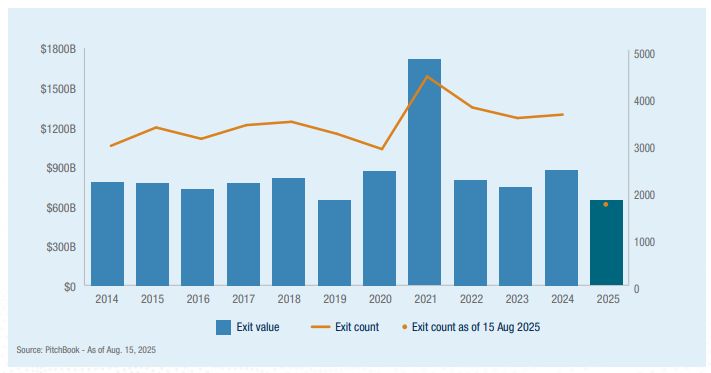
So far in 2025, global PE exits have reached $644.4 billion,
equivalent to 73% of 2024’s full-year total, buoyed by a
reopened IPO market and surging public equity valuations in the US.
While deal value figures indicate momentum, volume tells a more
sobering story, with exit deal count less than half of last
year’s, and an overall more sluggish IPO picture in
Europe.1
M&A activity has also seen improvements, with several
big-ticket, sponsor-led transactions injecting greater confidence
in the market. However, away from landmark deals, the M&A
environment for smaller companies – often less equipped or
slower to adjust to macro challenges such as tariffs –
remains challenging.
Global PE exits rebound
STRANDED ASSETS REMAIN A CONCERN
Despite these green shoots, PE funds still have a huge backlog
of ageing and unsold assets that must be addressed. Many of these
PortCos were acquired at premium valuations and with high leverage
during the frenzied Covid deal cycle. Since then, they have
confronted heavy macro headwinds with little balance sheet cushion,
compressing valuations and complicating their path to exit. In
addition, a growing number of PE firms are using continuation
vehicles to extend ownership of existing assets, allowing more time
for performance improvement, growth, and ultimately, value
recovery. Therefore we’re seeing General Partners (GPs) on both
sides of the pond having to work harder on every line of their
PortCo’s P&L to find new corners of outperformance.
According to our surveys, here’s how they are achieving this:
§ Transformation at scale: Marginal efficiency efforts or
quick cost take-outs will not solve the profound issues affecting
portfolio companies today: trade shocks, supply chain and
manufacturing disruptions, the rise of AI, to name just a few.
These require business-wide transformation combining high-impact
top line initiatives (e.g. commercial excellence, customer
experience, pricing) alongside cost-out and working capital
optimisation measures. Our survey confirms this trend, with most PE
funds across markets now expanding value creation scopes to include
more comprehensive operational transformation.
Operational transformation is now a priority, with most
US and European firms pursuing business-wide initiatives to drive
returns.
Revenue growth and cost reduction go hand-in-hand in
value creation, cited by 57% of US funds and 46% in Europe as joint
top priorities.
- Working capital to fund growth: PE firms are
intensifying working capital optimisation programmes as a way to
self-fund the transformation agenda within their portfolio
companies. Through targeted measures – including liquidity
account, accounts payable and inventory optimisation, factoring,
and sale and lease back – they are releasing trapped cash
within the business and reinvesting this capital into initiatives
that drive transformation. That approach allows PortCos to generate
momentum early in their transformation journeys and deliver results
sooner. - Focus on organic growth: Traditional cost-out
programmes are still essential within value creation, but no longer
the sole focus of PE firms. They are now focusing on larger scale
operational transformations, AI efficiency opportunities, and
revenue generation initiatives (pricing, service growth). The
increasing importance of organic expansion in light of higher
interest rates and challenging exit valuations is consistent across
markets, from the US to Australia. Some of the growth-oriented
initiatives being commonly pursued include marketing and customer
acquisition, pricing optimisation, cross- and up-sell
opportunities, and entry into new markets. - Digital, AI to scale and accelerate results:
Our 2025 surveys show that funds are becoming bolder in how they
deploy technology to drive business value creation. Across
geographies, and particularly in the more mature markets of the US
and Europe, the use of AI in post-acquisition value creation plans
has grown significantly compared to previous surveys, with use
cases expanding beyond back-office efficiency to more strategic
areas such as customer experience, pricing, and product portfolio
strategies.Notably, data and AI are being leveraged to accelerate large,
operational transformations. One example is the analysis of large
pools of data combined with prediction models to identify
operational improvement opportunities faster and with greater
precision. This accelerated “data-to-insight” process is
enabling a new generation of transformation programmes that are
more targeted, responsive, and scalable across portfolios.And while many firms are still experimenting, sophisticated use
cases within value creation are emerging. In our work with leading
PE funds across markets, we are helping clients apply AI tools to
reimagine customer journeys, enhance pricing decisions, and boost
sales team productivity.
45% of US and 41% of European funds report using AI in
value creation, with even higher uptake among large-cap
players.
Most common AI applications include data analytics,
operational efficiency and customer experience.
- Operating partners as catalysts for change:
Another clear insight from our annual surveys is the growing
importance of operating partners in executing value creation plans,
particularly as these become more ambitious. In the US, this model
has reached maturity, with an overwhelming majority of operating
teams directly involved in planning and executing value creation.
Similarly, in Australia, 70% of funds surveyed see operating
partners as the drivers of such programmes.Operating PE teams ensure that growth plans are realistic and
achievable. They bring together the various pieces of the
transformation puzzle, ensuring resources are deployed at the right
place and at the right time. Their operational expertise to
implement change on the ground complements the commercial focus of
deal teams. Finally, we observe funds more likely to rely on
operating partners than before, as management teams suffer from
decision fatigue in a more challenging economic environment.
Footnote
1.
The content of this article is intended to provide a general
guide to the subject matter. Specialist advice should be sought
about your specific circumstances.
link