
U.S. Cross-Border M&A: Mid-Year Outlook – Corporate and Company Law

The first two quarters of M&A
activity in 2025 have not achieved the banner-year levels that many
predicted; however, amid the uncertainty, there is still room for
optimism for a strong dealmaking environment to finish out the
year. We examine cross-border deal flows at the half-year mark to
provide insight into how tariffs and other trade developments
continue to shape the market sentiment—and the factors
hanging in the balance that could tip in favor of a more robust
deal environment for the remainder of 2025.
U.S. M&A deal environment
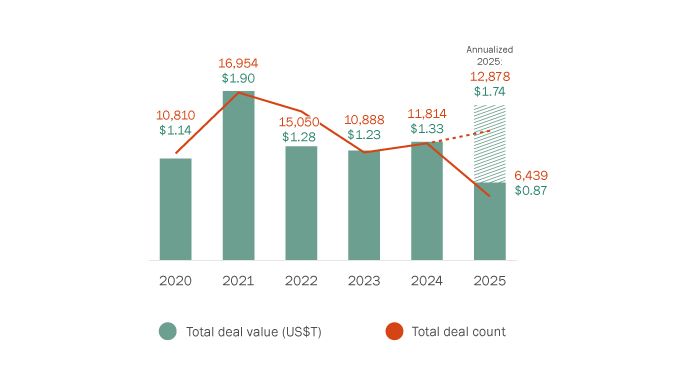
The picture of U.S. M&A deals remains mixed halfway into the
year, with combined global and domestic investment into U.S.
targets showing signs of a slowdown (see Figure 1), as ongoing
geopolitical volatility has had a chilling effect on dealmaking in
what was anticipated to be a comeback year for transactions. It
comes as no surprise that many dealmakers have opted for a
wait-and-see approach amid the flurry of U.S. tariff announcements
and the many subsequent pauses, adjustments and retaliatory
measures rolled out over the course of the last few months.
Dealmakers have also been impacted by stubbornly high U.S. interest
rates, as well as by uncertainty regarding the Trump
administration’s approach to antitrust enforcement.
That said, there are signs of life for deals involving U.S.
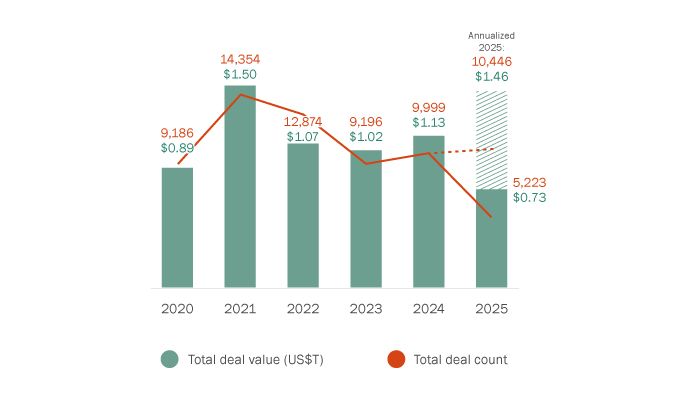
targets. U.S. domestic annualized deal value is projected to rise
moderately from $1.31 trillion in 2024 to $1.46 trillion in 2025
(see Figure 2), driven in part by high activity levels in
transactions exceeding $1 billion. This year is also currently on
track for a significant 29% YoY increase in deal value, though a
more moderate a 5% YoY increase in deal count for transactions
involving U.S. acquirers of U.S. targets (see Figure 2).
Figure 1: Deal value and count (any acquirer of U.S.
target)
Source: Bloomberg. Based on M&A deals announced during Jan
1, 2020 – June 30, 2025. Excludes terminated and withdrawn
deals.
Figure 2: Deal value and count (U.S. acquirer of U.S.
target)
Source: Bloomberg. Based on M&A deals announced during Jan
1, 2020 – June 30, 2025. Excludes terminated and withdrawn
deals.
Even as many deals remain paused, megadeals (with a value
greater than $1 billion) have sustained forward momentum. Whether
these megadeals represent a long tail of deals conceived in late
2024 or an optimistic indicator for 2025 remains to be seen. The
aggregate value of the 10 largest announced deals accounted for
around 34% of total deal value in the first half of 2025, with the
largest transaction valued at $39 billion (Sycamore Partners’
planned acquisition of Walgreens). Other notable announced
transactions include Charter Communications’ acquisition of Cox
Communications for $34.5 billion and Alphabet Inc.’s
acquisition of Wiz Inc. for $32 billion.
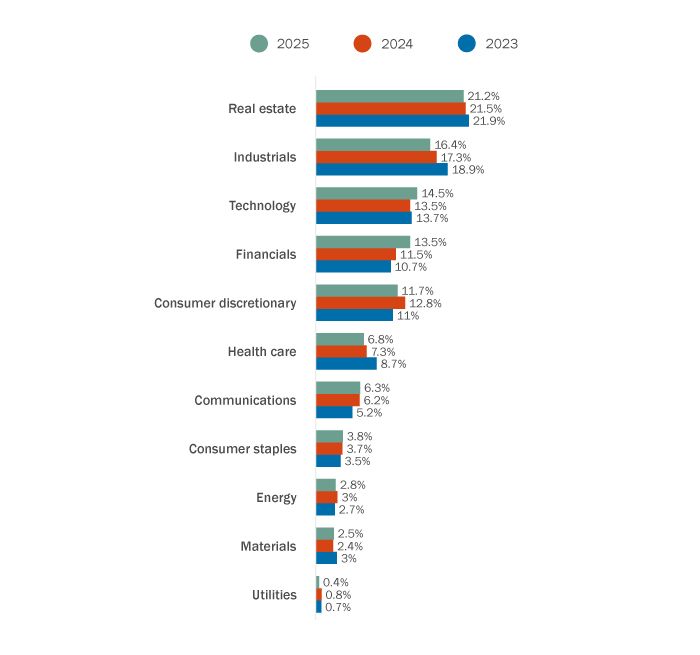
In terms of sector-focus, U.S. acquirers are finding
opportunities in real estate, which is the top sector by deal count
YTD (see Figure 3). New alternative real estate asset classes have
increased M&A activity in recent years1, while more
traditional real estate assets (e.g., housing and offices) remain
tied, in part, to the outcome of interest rates and the knock-on
effects from tariffs on construction costs, supply and valuations.
However, real estate’s intersection with digital infrastructure
(e.g., data centers, cables and energy-generating facilities) has
helped fuel some of 2024’s megadeals, including the $16 billion
acquisition of AirTrunk by Blackstone2, and show signs
of sustained growth for 2025. Technology also continues to be a
bright spot as investors remain engaged in cloud computing,
AI-enhanced software and cybersecurity, among other assets in the
tech sector tied to the AI boom. The market expectations for this
sector remain high and will likely continue to be a focus of
investment for the remainder of the year, as exemplified by
xAI’s acquisition of X Corp. for $33 billion in March.
Figure 3: Target industry breakdown (U.S. acquirer of
U.S. target)
Source: Bloomberg. Based on M&A deals announced during Jan
1, 2020 – June 30, 2025. Excludes terminated and withdrawn
deals.
Global deal flows
Investment from Canada into the U.S.
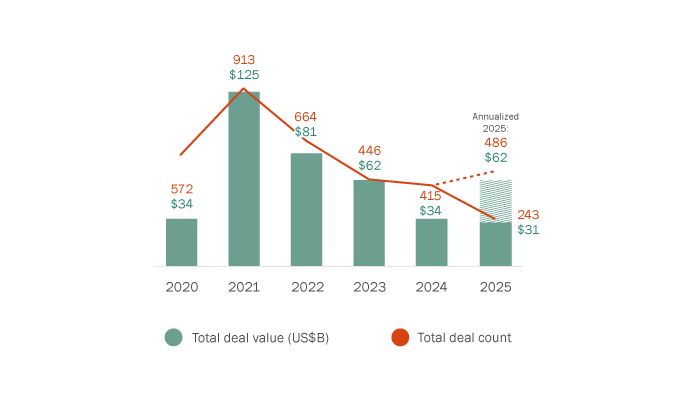
U.S. inbound investment from Canada seems unlikely to return to
high-water marks of 2021 and 2022; however, based on the projected
annualized deal value of $62 billion, it appears that 2025 may
prove to be a modest improvement over last year’s weak
performance. The continued slowdown of Canadian investment to the
U.S. from 2023 and 2024 is emblematic of the larger themes of
uncertainty in global trade relations as well as the particular
uncertainties in U.S.-Canada trade relations. On the other hand,
the promise of a potential U.S.-Canada trade deal (following the
rescission of Canada’s planned digital services tax) could
alleviate uncertainty for Canadian investors in the U.S. and
encourage M&A activity.
While deal volume remains low in most sectors after years of
high inflation and financing challenges, we continue to see
Canadian acquirers look to the U.S. for opportunities, with a
moderate uptick in the proportion of deals valued over $1 billion
and those valued between $100 million and $500 million compared to
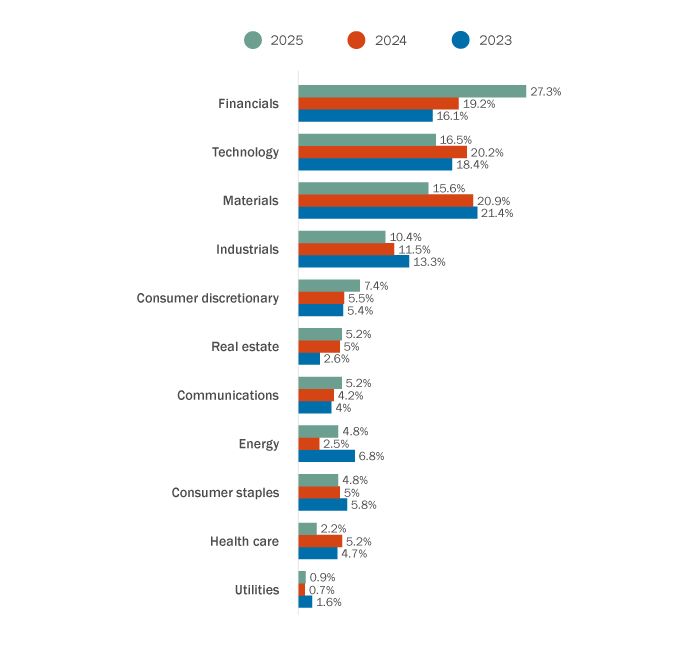
last year. In particular, Canadian acquirers in the financial
sector have accounted for the greatest proportion of U.S.-inbound
deals announced YTD, which are up 8% this year compared to the
proportion of deals announced in 2024 (see Figure 5). The share of
deals from energy acquirers has also seen a modest increase (3%
over 2024), which may reflect a renewed focus on energy security
acquisitions, such as Keyera Corp.’s deal to buy the Canadian
natural gas liquids business of the U.S. firm Plains, announced in
June3. Conversely, the share of deals by Canadian
acquirers in the materials sector is down 5% from last year, likely
due to the sector’s vulnerability to the whipsawing of U.S.
tariffs and retaliatory measures worldwide. Even before the most
recent announcement of 35% tariffs on Canadian goods, U.S. tariff
rates in 2025 have been at their highest levels since
19394, continuing to burden businesses with
international supply chains.
Figure 4: Deal value and count (Canadian acquirers of
U.S. target)
Source: Bloomberg. Based on M&A deals announced during Jan
1, 2020 – June 30, 2025. Excludes terminated and withdrawn
deals.
Figure 5: Acquirer industry breakdown (Canadian
acquirers of U.S. targets)
Source: Bloomberg. Based on M&A deals announced during Jan
1, 2020 – June 30, 2025. Excludes terminated and withdrawn
deals.
Investment from the U.S. into Canada
The current geopolitical environment is having a significant
impact on deals into Canada. Deal activity from the U.S. into
Canada appears to be softening following a stronger year in 2024,
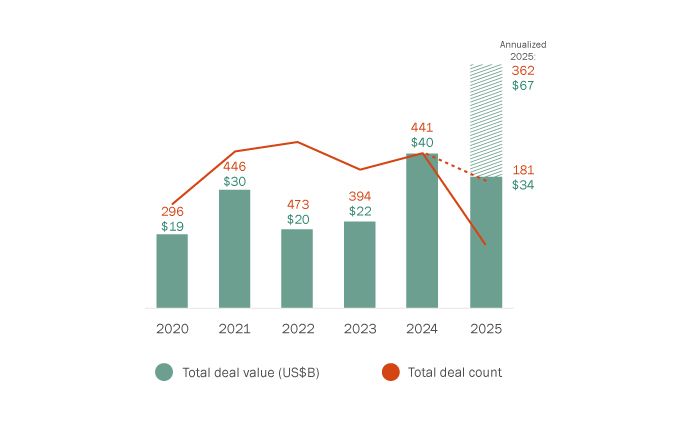
with annualized deal count projected to reach 362 deals, down from
last year’s 441 deals (see Figure 6). Adding to the chilling
effect, the Canadian government updated its Guidelines on the National Security Review of
Investments to consider, when reviewing foreign investment into
Canada, the potential of the investment to undermine Canada’s
economic security through the enhanced integration of the Canadian
business with the economy of a foreign state.
That said, deal value is expected to outpace last year at a
projected $67 billion (compared to $40 billion in 2024). This
points to a shift from last year for U.S. buyers of Canadian
assets, who are focusing on larger M&A deals. For example,
Sunoco’s planned $9 billion acquisition of Parkland Corp is the
largest announced deal involving a U.S. acquirer and a Canadian
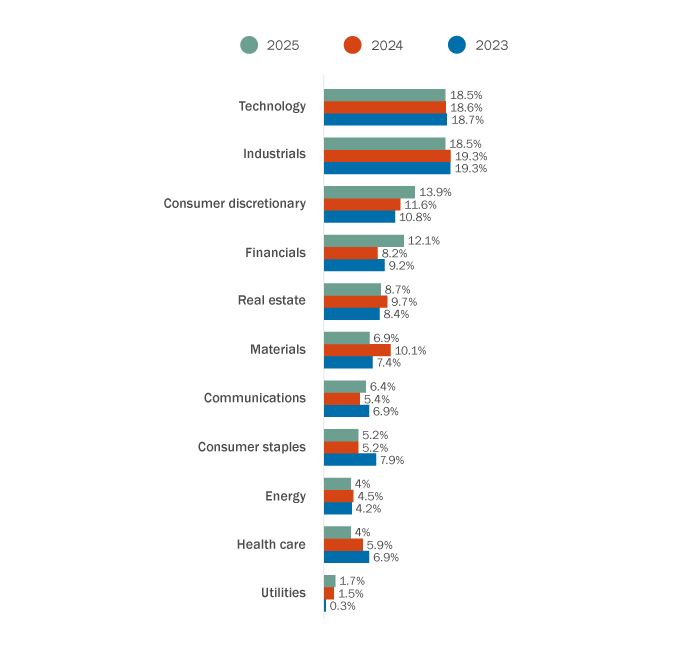
target since 2020. Transactions in the financial sector have grown
significantly (see Figure 7), likely bolstered by steadying
inflation rates as the Bank of Canada maintains its target interest
rate at 2.75%5. Industrials are down somewhat but retain
their status over the last three years as a top target industry.
Notwithstanding tariff risk, industrials’ strong earnings and
tailwinds from infrastructure activity suggest that this sector
will continue to remain of interest for U.S. acquirers.
Figure 6: Deal value and count (U.S. acquirer of
Canadian target)
Source: Bloomberg. Based on M&A deals announced during Jan
1, 2020 – June 30, 2025. Excludes terminated and withdrawn
deals.
Figure 7: Industry breakdown (U.S. acquirer of Canadian
target)
Source: Bloomberg. Based on M&A deals announced during Jan
1, 2020 – June 30, 2025. Excludes terminated and withdrawn
deals.
Spotlight on Japan
Japan has gained significant traction on the global M&A
stage in the last several years. Market reforms and shareholder
activism aimed at increasing shareholder value have led to
increased Japanese investment into North America. Annualized deal
value for Japanese acquirers of U.S. and Canadian targets is up so
far in 2025 (by 43% for Canadian targets in
particular)6. Canada’s consumer discretionary,
materials and consumer staples are the top target for Japanese
investors, with a focus on smaller transactions (less than $100
million). Investment from Japan into Canada is further supported by
the two countries’ collaboration on the Comprehensive and
Progressive Agreement for Trans-Pacific Partnership, which
eliminates or reduces tariffs on most key Canadian exports to
Japan, including for agriculture, seafood, forestry, and metals and
mineral products7.
Conclusion
While 2025 has so far not met market expectations, there have
been improvements over 2024 and dealmaking may rebound further
depending on how several issues play out, including tariff
policies, inflation rates and overall market sentiment. Buyers and
sellers may adjust their playbooks once again as countries,
including Canada, continue to negotiate trade deals with the United
States8. If tariff and trade tensions settle, investors
may be able to more precisely make the assessments they need to get
deals over the finish line, with the possibility of increased
activity towards the year’s end.
Footnotes
1. See PwC, “Global M&A Trends in Real Estate”,
(June 24, 2025).
2. See Blackstone, “Blackstone Announces Agreement to Acquire AirTrunk
in a A$24B Transaction”, (September 4, 2024).
3. See BNN Bloomberg, “Keyera says $5.15 billion deal to buy Plains’
Canadian business to help energy security”, (June 17,
2025).
4. See EY, “US economic outlook May 2025”, (June 20,
2025).
5. Bank of Canada, “Policy interest rate”, (June 4,
2025).
6. Source: Bloomberg. Based on M&A deals announced
during Jan 1, 2020 – June 30, 2025. Excludes terminated and
withdrawn deals.
7. See Government of Canada, “Canada-Japan relations”, (June 7,
2025).
8. The Financial Post, “Where does Canada stand as Trump’s tariff
deadlines loom”, (July 8, 2025).
The content of this article is intended to provide a general
guide to the subject matter. Specialist advice should be sought
about your specific circumstances.
link