Where’s My MOIC? The Value Creation Officer – Corporate and Company Law

Ankura Consulting Group LLC are most popular:
- within Compliance topic(s)
Amidst private equity’s shifting paradigms, success
increasingly relies upon unwavering focus and relentless execution
against identified value creation levers. Historical value levers
like organizational optimization and redesign, footprint and
network rationalization, and performance and process improvement,
remain necessary arrows in the quiver; but there is a larger
opportunity for private equity sponsors to unlock even more value
by modernizing the organizational constructs used to pursue value
creation at speed.
Most recently, the rise of the Transformation Management Office
(TMO) and the appointment of a designated TMO Leader advanced
portfolio companies’ pursuit of value creation. But even this
model has its limitations and can sometimes fail to deliver
Multiple on Invested Capital (MOIC) in line with sponsor
expectations. While sources suggest that transformations have
failure rates exceeding 70%1, the TMO remains the most
prevalent construct for delivering value across business and
functional lines.
Reflecting on the successes and shortcomings of the
Transformation Management Office, we suggest that there may be a
better way. In fact, historical performance creates a compelling
case for a dedicated Value Creation Officer (VCO) within a
portfolio company’s leadership levels.
Structure Dictates Function
As true in business as it is in science, structure dictates
function. While Transformation Management Offices are defined to
unlock value through combinations of growth strategies, working
capital improvement, cost reduction and avoidance, and digital
modernization, application of TMOs in private equity environments
has its limitations. A modified approach adapted to the needs of
portfolio companies may help companies reach their full potential
more quickly.
From a structural perspective, TMOs often operate
programmatically, addressing an identified set of initiatives on an
agreed upon workplan. For some organizations, this level of
structure, rigor, and sequencing is necessary and beneficial.
However, whereas TMOs often evolve into a supercharged execution
engine, the private equity landscape increasingly demands a more
adaptive model that allows for greater agility and a maniacal focus
on MOIC.
Second, TMO leadership roles often experience varying levels of
support and conviction from their C-Suite colleagues. While
transformation requires close alignment with CFO and COO agendas in
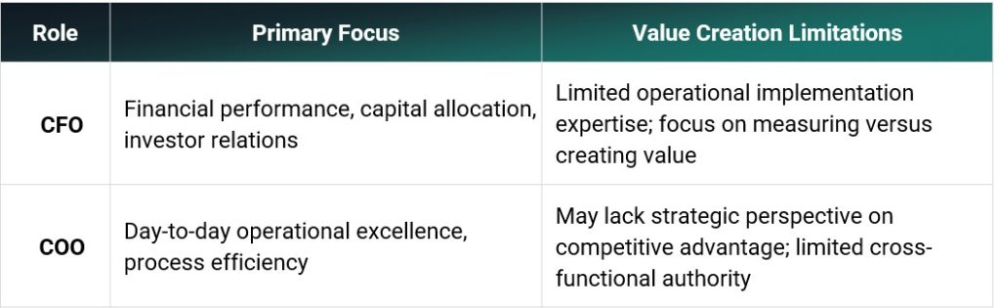
particular, neither the CFO nor COO is uniquely focused on value
creation as its singular priority; both may have interests that
compete or conflict with transformation priorities.
The Value Creation Officer
Defined correctly, the Value Creation Officer resembles an
experienced operator with a singular focus on value realization.
Unlike traditional transformation roles that emphasize process
coordination and execution, the VCO operates as the primary
architect of value creation with direct accountability for MOIC
improvement. It complements the CFO and COO agendas by delivering
material financial and operational improvements while also
mitigating structural gaps in C-Suite accountability by providing
dedicated leadership for systematic value realization. Whereas the
CFO and COO operate their respective functions, the VCO enables
both to accelerate change.
Several defining characteristics distinguish the Value Creation
Officer from its predecessor roles:
- Primary focus on value creation and frequent (re)calibration
toward a company’s highest potential opportunities (as measured
by MOIC)
- Board and CEO-level sponsorship provides sufficient support to
quickly cut through red tape and navigate organizational
resistance
- Close partnership and complementary support for other C-Suite
members
- Elevated expectations of disruption and change tolerance are
known and accepted
- Decision-making authority enabled by P&L responsibility and
direct reports and/or ability to create functions as needed
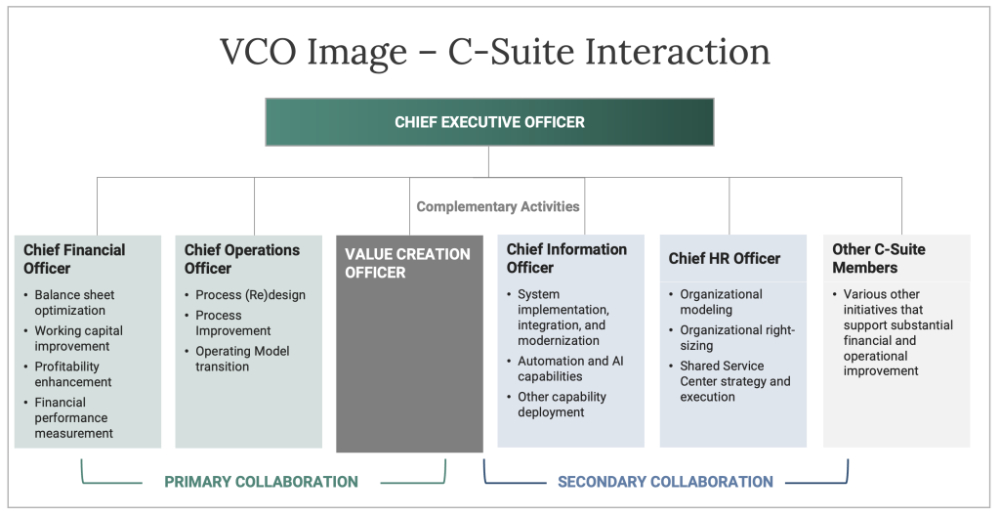
Common C-Suite interactions and complementary activities of the
VCO are shown below:
Ongoing Value Realization with Future-Focused
Transformation
With a clear mandate to deliver immediate impact, the Value
Creation Officer is also responsible for reimagining historical
ways of working and introducing new technological advancements.
None of these is more important in today’s dynamic environment
than artificial intelligence. AI holds the promise of automating
and simplifying complex workflows, generating internal and external
insights, identifying competitive or market opportunities, and
fundamentally reinventing how we work. It needs to be a crucible
capability both in theory and in practice of the Value Creation
Officer.
AI transformation requires sophisticated management that
combines technical implementation expertise with business model
innovation and organizational change management. The VCO will
possess essential capabilities for technical value realization,
cross-functional coordination, and systematic performance
measurement linking technology implementations to business value
creation.
Additionally, the VCO is someone who thinks big and actively
pursues transformative AI use cases. According to a 2025 study from
the Massachusetts Institute of Technology2, 95% of AI
pilots fail in part because they “lean on generic tools…
[and] are stuck in high-adoption, low- transformation mode.”
Those that are successful, the article argues, are designed for
friction and are embedded into high-value workflows. The Value
Creation Officer is perfectly positioned to drive this change.
Core VCO Functions
While VCO functions should be adapted to the specific needs of
each individual company, most companies share at least some common
needs. These can be used as a starting point when defining the VCO
role:
Value Opportunity Identification and
Quantification
- Assess value creation potential across business dimensions
- Utilize AI-driven analytics to identify new or emerging value
opportunities
- Quantify MOIC impact for all value creation initiatives
Value Capture Architecture
- Design and implement value realization mechanisms
- Prioritize, calibrate, and recalibrate opportunities within a
dynamic roadmap
- Assign top-down ownership and mandates for selected value
creation opportunities
- Coordinate across business and functional lines to ensure
operational changes translate to anticipated financial
improvements
- Integrate technology initiatives with business and operating
model innovation
Performance Accountability and Measurement
- Own MOIC measurement and realization throughout the holding
period
- Implement leading and lagging indicators that predict value
creation outcomes
- Incorporate leading and lagging indicators into recurring
reporting mechanisms
- Balance sustainable value creation vs. short-term performance
improvements
Investment Thesis Bridge
- Communicate business performance and value creation progress to
sponsors, balancing both operational realities and sponsor return
expectations
- Own portfolio company performance optimization
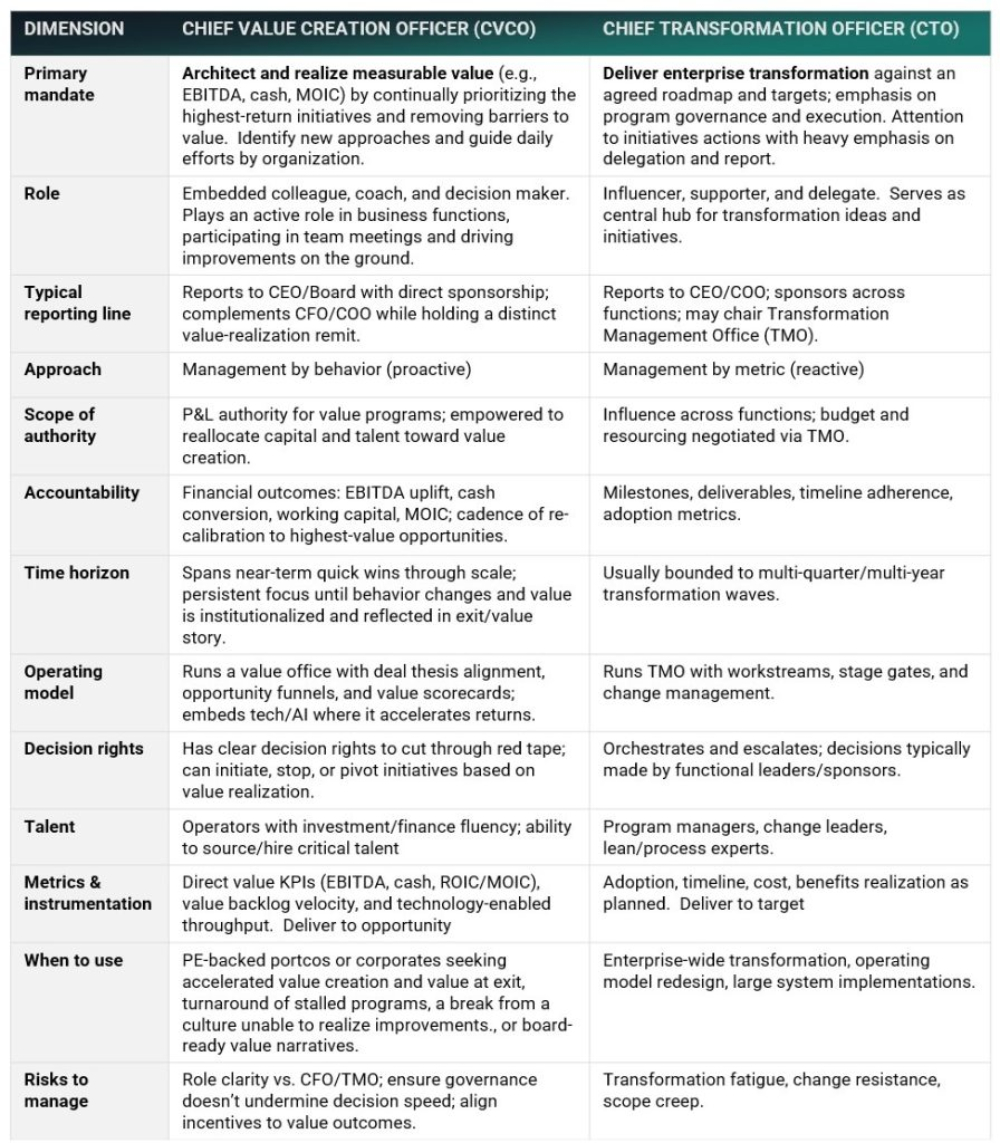
VCO vs. CTO
The VCO and CTO each have key, but different roles in executing
a transformation.
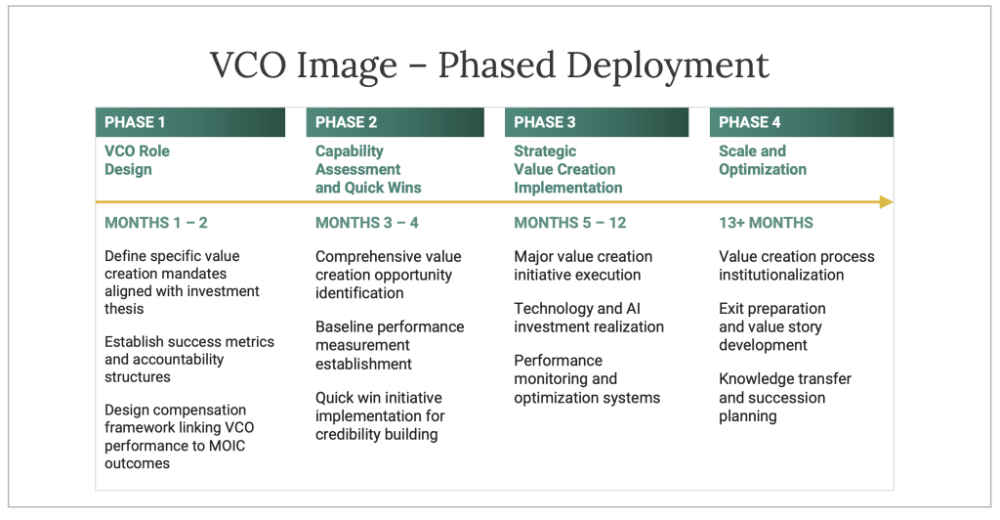
Getting Off the Starting Line
If your company is one of the many that would benefit from the
introduction of a Value Creation Officer, we recommend the
following approach:
While the real benefit comes through execution of a defined
value creation program, this approach provides a proven methodology
that can serve as a starting point for your company.
The Strategic Imperative
The VCO role reflects private equity’s recognition that
sustainable returns increasingly depend on systematic operational
improvements. As competition intensifies and exit multiples face
pressure, the ability to identify and capture value through
dedicated leadership becomes the primary differentiator between
successful and mediocre investment outcomes.
This is a fundamental shift toward accountability-driven value
creation and alignment of portfolio company management with sponsor
return objectives. When structured effectively, the VCO bridges the
gap between transformation ambition and MOIC realization.
How Ankura Office of the CFO® Supports VCO
Implementation to Value Realization
Ankura Office of the CFO® brings together
seasoned financial and operational leaders who understand the
complex challenges of delivering measurable MOIC improvement. Our
VCO implementation approach emphasizes practical execution and
sustainable value creation capabilities. The goal is not the
process, it is to capture the prize, value realization with speed
and urgency.
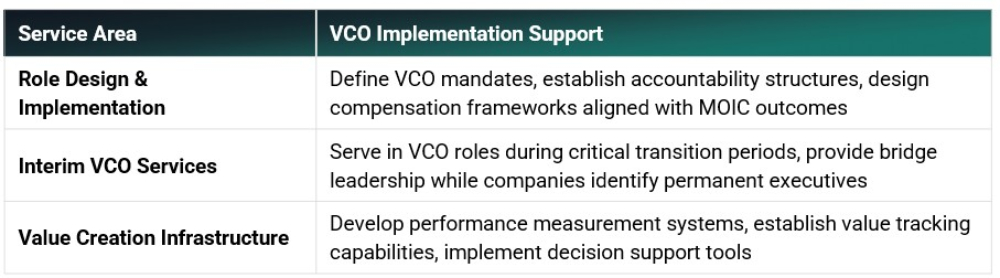
Our practice is distinguished by implementation focus—we
measure success by tangible value creation rather than
recommendations quality. We engage as partners, aligning incentives
with outcomes and adapting approaches to unique organizational
contexts.
Sources
1 Kotter, J.P. (1996). Leading Change. Boston: Harvard
Business School Press
2 Snyder, J. (2025, August 26). “MIT Finds 95% of
GenAI Pilots Fail Because Companies Avoid Friction.”
Massachusetts Institute of Technology.
The content of this article is intended to provide a general
guide to the subject matter. Specialist advice should be sought
about your specific circumstances.
link