Chattanooga VW employee tells Congress company violated labor law
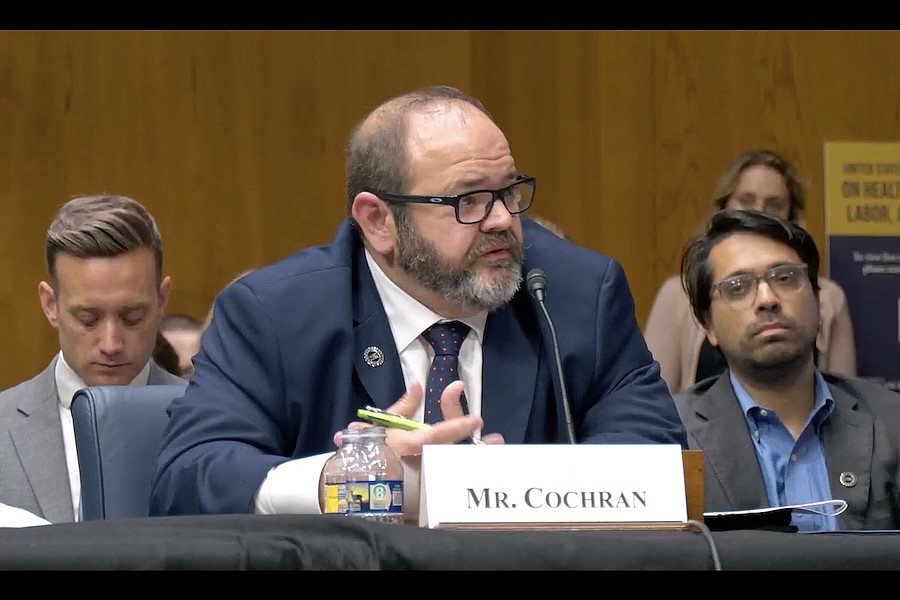
A 14-year Volkswagen employee brought his concerns about the company to Congress this week, stating the German automaker has repeatedly violated labor law in the two years since Chattanooga workers voted overwhelmingly to join the United Auto Workers union.
“They have unlawfully cut jobs at the Chattanooga plant,” Steve Cochran, a skilled trades worker and cochair of the UAW bargaining committee, told lawmakers. “They have unlawfully refused to bargain in good faith. They’ve presented us with a quote-unquote ‘final offer’ that maintains subpar health care, doesn’t protect our wages from inflation. It makes no commitment to keeping the good jobs in Chattanooga there.”
Cochran was one of five speakers — including the president of the International Brotherhood of Teamsters, Sean O’Brien — who testified in front of the Senate Health, Education, Labor and Pensions Committee on Wednesday morning about reforming labor laws.
“After workers vote to form their union, many employers delay the negotiation of an initial bargaining agreement,” O’Brien told senators. “Nearly half of new unions failed to secure a contract within a year of winning an election. After two years, a third are without a contract.”
(READ MORE: UAW taking temperature for strike at Volkswagen Chattanooga)
In April 2024, Volkswagen employees by a roughly 3-to-1 margin voted to join the UAW. Negotiations began on the contract that September, and a year later, VW has presented what the company calls its last, best and final offer to the union.
“We still do not have a union contract,” Cochran said Wednesday. “We’re still waiting for the company to agree to a proposal that simply affords us a fair share. We are living with health care that forces people into bankruptcy. We are living with no protection from inflation. The company has repeatedly violated labor law to delay us our fair share.”
Michael Lowder, a spokesperson for Volkswagen, said the company has been negotiating in good faith and in full compliance with the law since negotiations kicked off nearly a year ago.
VW’s proposal would raise wages 20% through 2029, add a cost-of-living allowance, reduce health care costs and introduce profit-sharing. Employees would also get a $4,000 ratification bonus — plus an additional $1,500 if they approve the deal by Oct. 31 — and two new floating holidays.
“The response from our employees has been overwhelmingly positive, and it is time for the UAW to let VW employees vote and decide for themselves,” Lowder said in a statement. “It is disappointing that the UAW is focused on pursuing baseless labor charges and building support for a strike instead of listening to their membership.”
BREAKING THE LAW
In a news release Sept. 30, the UAW said the National Labor Relations Board recently found Volkswagen “egregiously violated the law in intimidating, disciplining and threatening workers” at its parts distribution center in Cranbury, New Jersey. The New Jersey facility filed to join the UAW earlier this year, and a vote in April was 81 to 62 against unionization.
Volkswagen officials said the federal labor board has not determined that Volkswagen broke the law, noting the complaint is still in an early stage of the process and no formal decision has been made in this case.
With a federal government shutdown entering Day 9, a message on the board’s website Thursday said the office is closed because of a lapse in appropriated funds. Asked about the disagreement, the board’s executive secretary, Roxanne Rothschild, said in an email the agency has no comment at this time.
(SIGN UP: Get Business news from the Times Free Press in your inbox five days a week by going to timesfreepress.com/business)
Cochran cited the issues in New Jersey during his testimony. The federal labor board found merit in the company’s allegations, he said.
“We know this company and many other companies break the law,” Cochran said. “We know it’s possible to enforce the law and force companies to negotiate with their workforce. Why are we not getting the support in Tennessee? Why does Volkswagen get to break the law and screw Tennessee autoworkers out of their fair contract?”
U.S. Sen. Bernie Sanders, an independent from Vermont, said Volkswagen made $17 billion in profits and could afford to pay its CEO, Oliver Blume, $11 million in total compensation. It’s been 526 days since Chattanooga workers voted to join the UAW, Sanders said Wednesday.
“Do you believe Volkswagen can afford to give your members a decent contract with fair wages and benefits?” Sanders asked Cochran.
“Of course,” Cochran responded. “Anybody understands they can. Less than 4 cents for every dollar they make goes to the worker in Chattanooga for the cars we sell.”
‘SLAP IN THE FACE’
The UAW has filed formal labor charges against Volkswagen three times this year, according to documents. The National Labor Relations Board oversees these disputes.
In March, the union alleged Volkswagen violated federal law by making unilateral changes to the terms of employment for workers and circumventing the union to directly deal with members of the bargaining unit, according to filings. That charge was specifically related to VW’s announcement in March that it would return to a primarily two-shift production schedule in Chattanooga, saying it would offer voluntary buyouts to cut its workforce.
(READ MORE: UAW says it has received ‘overwhelming’ response to strike pledge cards in Chattanooga)
This month, the UAW alleged VW refused to bargain in good faith by making regressive proposals and failing to bring representatives with decision-making authority to the bargaining table. VW has also suggested it would terminate or discipline employees who engaged in protected activity, including a strike, the union said.
“Your average worker has to fight like hell to win their union against constant illegal activity from their employers,” Cochran said. “If they overcome that to win their union, they have to fight like hell to win their union contract and actually improve their lives. This process can take years, and every year, this is a slap in the face of the workers who make these companies profitable.”
In a video statement Sept. 26, UAW lead negotiator Chuck Browning said VW’s proposal is an incomplete document, stating there is language missing on topics that had already been tentatively agreed to by the bargaining team and the company. The union said Volkswagen’s corporate board also hasn’t approved the deal. Cochran said Wednesday Volkswagen’s offer is full of “clerical errors.”
“They’re not letting people see the entirety of it,” Cochran told lawmakers. “That’s something, until all that stuff is settled out, how do we bring it back to our workers?”
COMPANY RESPONSE
Volkswagen has denied these claims. The UAW has not responded to the company’s last, best and final offer, a Volkswagen official said. The union asked questions about some pages missing from the proposal and whether the company had board authority to pass the offer. Company officials confirmed they did have approval. The company has clarified every question from the union, the Volkswagen official said.
The union has claimed the offer is incomplete because Volkswagen didn’t include all the tentative agreements in the proposal, the official said. There are more than 300 tentative agreements, according to the company, and in the offer Volkswagen presented to the union, there is a passage that states the proposal incorporates all tentative agreements that have been reached by the parties since around September of last year.
The union has essentially been stalling as it tries to gain enough momentum for a strike in a Chattanooga, a company official said, but if the organization had enough support for a strike, it would have already done so.
(READ MORE: Sales of Volkswagen’s Chattanooga-made ID.4 jump 176%)
In reference to the labor charges, a Volkswagen official said the National Labor Relations Board has not taken action on the complaint filed in March. While the sides were bargaining about reducing a shift earlier this year, the UAW wanted affected employees to receive up to two years of severance and two years of health insurance, and negotiations ultimately broke down over the course of multiple meetings, a company official said.
That type of severance would have been more in line with agreements the UAW has with other large automakers, but those companies have more flexibility than VW because they have multiple plants in the United States and can shift workers to another facility, a Volkswagen official said.
Talking about the second filing in September, a company official said Volkswagen negotiators received parameters from the board that dictated how far they could go during bargaining talks.
DRUG TEST ISSUES
Addressing the claims of regressive bargaining, the Volkswagen official said there were two of about 300 tentative agreements the company withdrew. In one case, the company wrote language that would eliminate random drug testing, which the union interpreted to include drug testing after an accident, the company official said.
The UAW asserted Volkswagen would only be able to require a drug test if there’s probable cause, the VW official said. However, Tennessee regulations state accidents that result in injuries give employers probable cause to test. The union wouldn’t agree to that, so the company withdrew the provision, the Volkswagen official said.
In the second case, VW had agreed to discuss the economics of offering a child care subsidy, although the company had not settled on a number. The union wanted about $100 a week per child, a Volkswagen official said, but it did not become a priority for the UAW at the negotiating table.
Regressive bargaining, according to the UAW, is when a party moves backwards on an issue, offering less than they previously had on the proposal.
The Volkswagen official had not reviewed the third charge filed by the UAW, but the company has informed employees that workers will not receive pay if they choose to go on strike. Those employees would also lose their health care benefits at the end of the month.
Contact business reporter David Floyd at [email protected] or 423-757-6249.
link